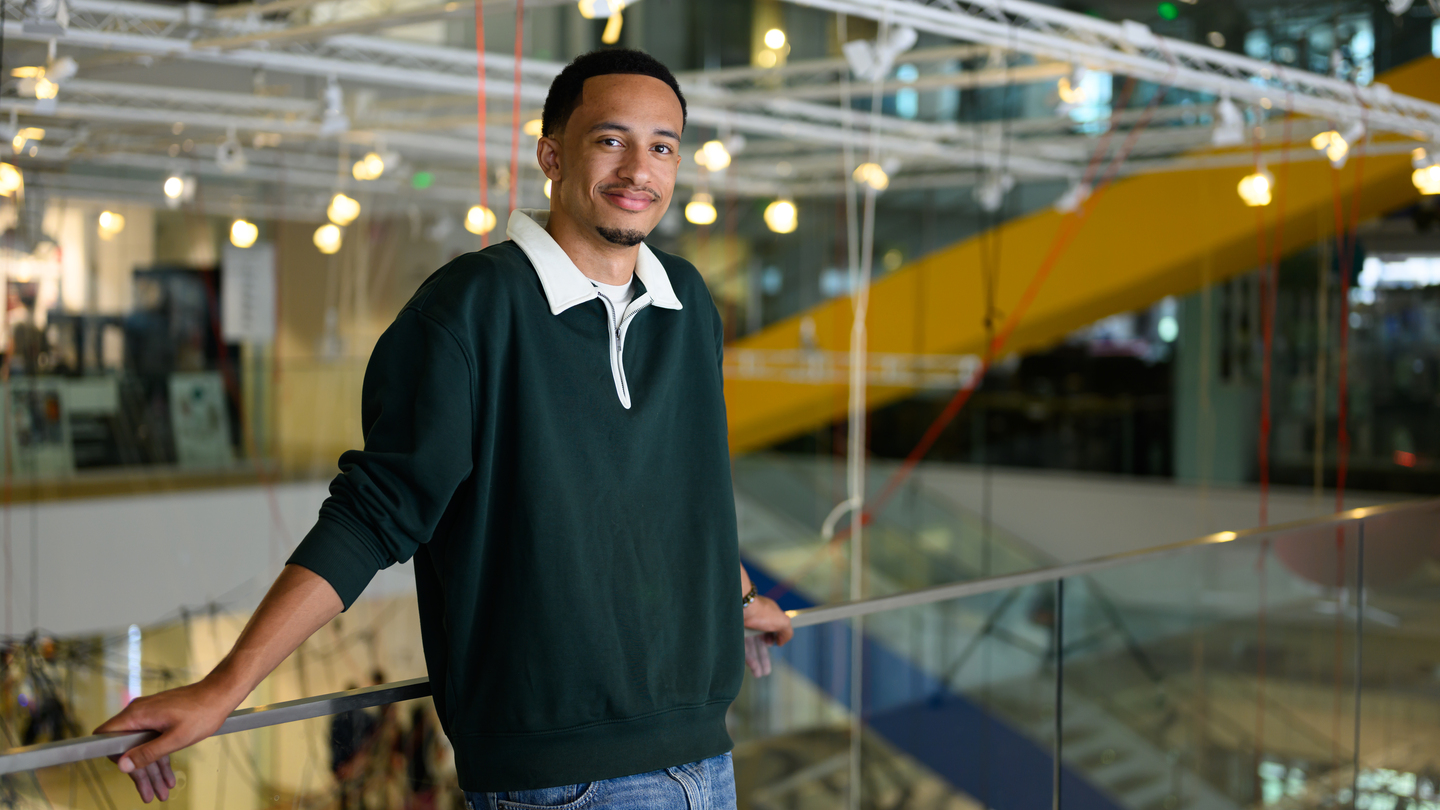
“I think that a game can be made about anything,” says Kayode Dada, a rising senior majoring in mechanical engineering. “But to make a good game,” he adds, “it takes a lot of time and effort and thinking about it.”
Dada has been thinking about games seriously since he was a teenager, but he took an interest in them much earlier. Growing up in Louisville, Kentucky, he and his brother would play card games, board games, and video games for hours. His face lights up as he recalls some of his favorites, including “Dungeons and Dragons,” “Catan,” “Yu-Gi-Oh!,” and “Risk.” During the Covid-19 pandemic, his family developed a nightly ritual. “For weeks and weeks, every single night we’d play a full game of ‘Monopoly.’ It was crazy!” he recalls.
Even as a kid, Dada wondered about the mechanics and decisions that went into the games he played, but it wasn’t until high school that he tried his hand at game design. He created his first game by constructing dice with different sides using arts and crafts materials. From there, the ideas kept coming. He figures during those years he designed about 25 games; he made nine of them and gave them to friends for their birthdays.
Much of his application to MIT revolved around board game design, too. At first, he didn’t believe MIT would accept him because he didn’t “do any real tech stuff,” Dada says. But reading the MIT Admissions blogs changed that — particularly a post by a computer science major who wrote that she had no coding experience before coming to MIT.
“That gave me motivation and hope that I could apply with a bunch of cardboard games, and I got in,” he says. “It was really cool to see, through the eyes of current students, that they are not all super-duper geniuses in an unattainable sense. They’re real.”
Now, Dada has created his biggest and most ambitious game yet: a trading-card game for 1,100 incoming first-year students during MIT Orientation in late August.
“Building up the next class”
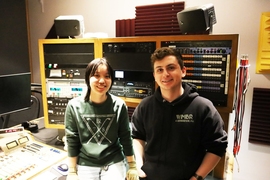
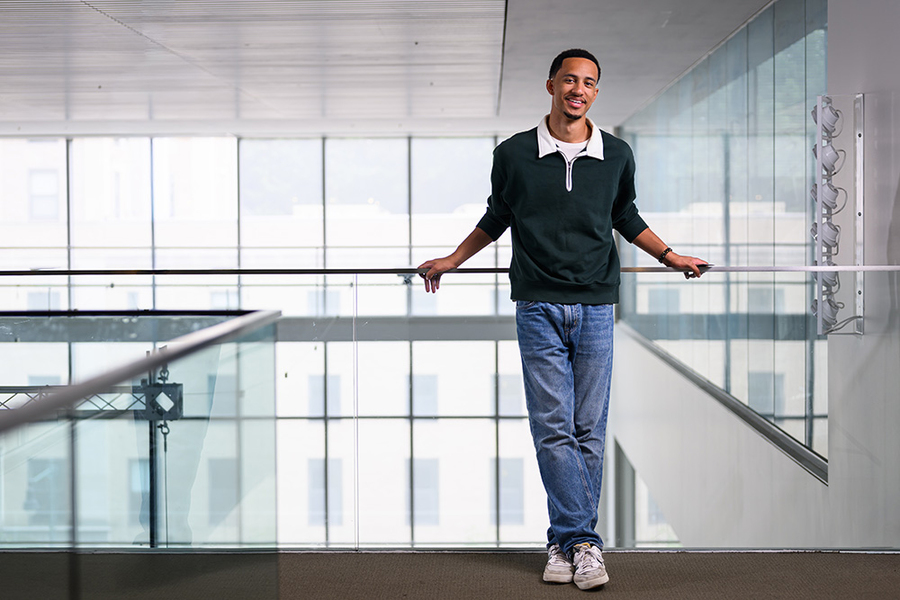
Since he’s been at MIT, Dada has thrown himself into in a number of extracurricular activities and had less time to devote to game design; he’s now an MIT Admissions blogger himself, an orientation captain, a leader in MIT Cru (a campus Christian group), a drummer in the MIT Live student music group, and a DJ on WMBR 88.1 FM (his show, “Midwest Pizzeria,” features Midwest emo math rock).
For Dada, blogging and serving as an orientation captain are meaningful ways that he can help build community and increase awareness about the plethora of opportunities for students. He recalls one post he wrote about being a Christian at MIT that really struck a chord with readers.
“I got a lot of emails from either students interested in the club or parents and high school counselors saying, ‘Thank you for posting this — I had no idea,’” he says. He also hears from a lot of students who don’t think they have what it takes to get into MIT. “I tell them, ‘I think you should still apply … and regardless if you get into MIT or not, you’re going to do amazing things.’”
This summer will be his third MIT Orientation. He loves it.
“It’s a lot of fun to talk to students, hear what they are interested in, and then be like, ‘Oh, you should definitely go check out this thing. I’ll connect you to this person that you should talk to,” he says.
In a fun twist of fate, some of the orientation leaders he works with read his blogs as prospective students. And he has met some of his best friends through orientation: “[They] are as interested as I am in helping out the people coming in … giving it back to MIT and contributing towards building up the next class.”
Re-orienting orientation
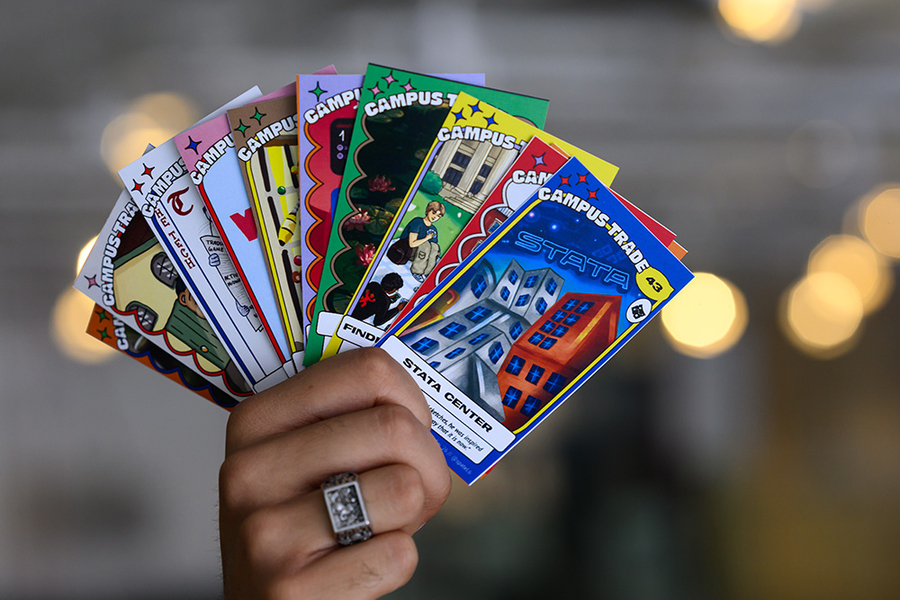
Last year, Dada’s interest in game design intersected with his role at MIT Orientation. The staff had been brainstorming games to try to keep the new students engaged between events, and Dada offered to create a trading-card game that would also serve as an ice-breaker. His game, “Campus Trade,” capitalized on the fact that the students are divided into 12 groups designated by a different color. Each student would start with 12 trading cards the color of their group, and by the end of the week they had to collect one card from every other group — in other words, 12 different colors.
The game was a hit. “They got so invested immediately, and we couldn’t get them to stop playing and go back inside to the next meeting,” Dada says.
Nonetheless, he made some key observations watching them play — including the fact that many of the students would just trade cards and walk away, without talking much.
He decided to redesign “Campus Trade” and connected with Cassandra Lee, a research designer in the MIT Media Lab’s Center for Constructive Communication, whose interests include the connection between games and social interaction. Under her supervision, he spent his junior year doing an Undergraduate Research Opportunities Program project through the realtalk@MIT program, which supports students who design and organize their own creative community infrastructure.
After months of prototyping, interviewing students, testing, and iterating, Dada is ready to roll out the game. This year’s “Campus Trade” cards are bigger — tarot-sized — and feature current MIT students’ artwork on one side, depicting a person, place, or thing from campus. On the other side there’s an icebreaker question. The game is designed in such a way that there are multiple ways to win, to encourage collaboration.
Working on “Campus Trade” with Dada was a “sincerely rewarding collaboration,” Lee says. “Community development work really requires a student who understands and is willing to fight for the value of people, stories, and being in community. Consistently throughout this project, it was clear that Kayode is more than capable of balancing his own spirit with the grueling organizing work that makes a project like ‘Campus Trade’ possible.”
Ultimately, Dada hopes to pursue a career in game design after he graduates. He thinks about games a lot, lying awake at night, or even in church.
“Before, I didn’t really believe I could do it,” he says, “but now that I have this project under my belt, some real experience working on a game on a large scale, I definitely have a lot of ideas.”
He figures he’ll either apply for a job at a game design company like Wizards of the Coast, or maybe even start his own company and “just see how it goes.”
And why not? After all, he took a chance when he decided to apply to MIT — and that turned out to be exactly the right move.