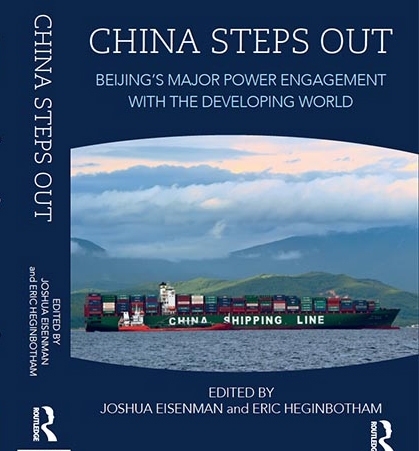
Beijing’s strategy toward developing countries is the focus of “China Steps Out: Beijing’s Major Power Engagement with the Developing World,” a new book co-edited by Eric Heginbotham PhD '04, principal research scientist at the MIT Center for International Studies and Joshua Eisenman, an assistant professor at the LBJ School of Public Affairs at the University of Texas at Austin.
The book features contributions by a diverse group of experts who independently analyze and explain China’s engagement practices in Southeast Asia, Central Asia, South Asia, Africa, the Middle East, and Latin America and evaluates their effectiveness. In addition to writing the chapters on China in Southest Asia and Africa, respectively, Heginbotham and Eisenman co-authored the volume’s introduction and concluding chapters.
The book unpacks and summarizes how China pursues its objectives and how other countries perceive and respond to China’s growing influence. Through the application of a comparative politics research design, they differentiate China’s approach based on each region’s economic, political, military, and social characteristics. In this way, Heginbotham and Eisenman identify the unique features of Chinese engagement in each region in addition to the developing world as a whole.
“‘China Steps Out’ tracks the important shifts in China’s diplomacy, including the increased weight Beijing places on political and economic relationships in the developing world; a more differentiated approach to those areas, including a distinction between ‘newly emerging powers’ and others; and its new interest in fostering strategic military relationships in parts of the developing world,” Heginbotham says. “These are all parts of Xi Jinping’s ‘major power relations.’”
Heginbotham was the lead author of the RAND Corporation’s “China’s Evolving Nuclear Deterrent” (2017) and “US–China Military Scorecard: Forces, Geography, and the Evolving Balance of Power” (2015), as well as co-author of “Chinese and Indian Strategic Behavior: Growing Power and Alarm” (2012).
Ambassador Paula Dobriansky, a former U.S. under secretary of state for global affairs, calls the book a “brilliant guide for policymakers and academics alike.”
“The authors masterfully detail China's strategic goals and expansive relations with the developing world through comparative regional analyses and unique insights,” she says.
Eisenman, who last week provided testimony to the U.S.-China Economic and Security Review Commission on themes central to the book says the book is “suited to anyone trying to gain a better understanding of China’s strategic intentions in the developing world, particularly the Belt and Road Initiative and what it means for the United States and the world.”
Eisenman is the co-author of “China and Africa: A Century of Engagement” (2012). His next book, “Red China’s Green Revolution: Technological Innovation, Institutional Change, and Economic Development Under the Commune,” will be released in April 2018.
Book launch events for “China Steps Out” are scheduled for the Royal United Service Institute in London on March 13, and the Center for Strategic and International Studies in Washington on March 22. Additional events are also being scheduled.