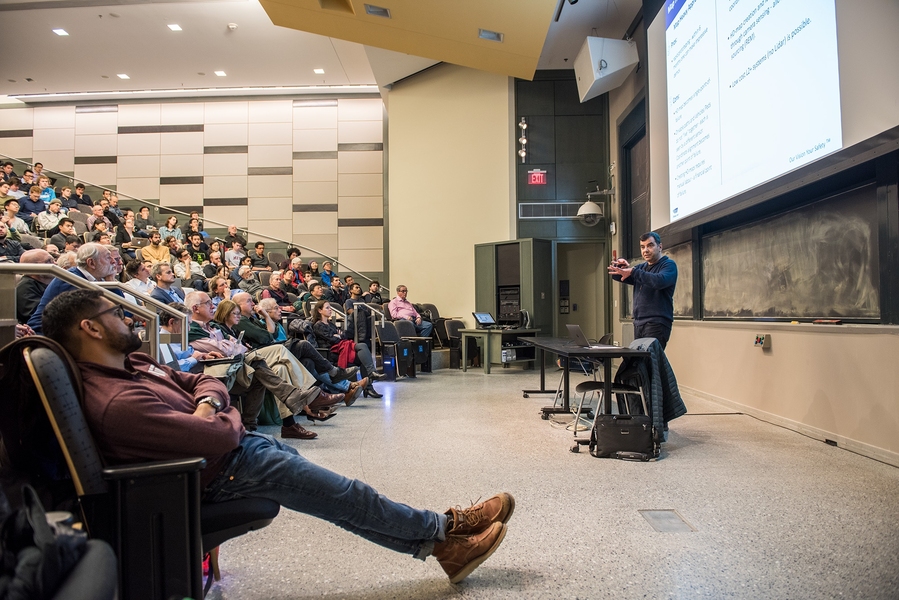
The field of transportation is undergoing a seismic shift with the introduction of autonomous driving — or computer-driven cars. Computer vision scientist and Mobileye co-founder Amnon Shashua PhD ’93 described the challenges associated with this technology in a talk last month hosted by MIT’s Center for Brains, Minds and Machines (CBMM).
The technology behind computer driven cars, Shashua explained, involves machine learning and the latest cutting-edge artificial intelligence algorithms in three major areas: sensing, planning, and mapping.
Shashua earned his PhD in the Artificial Intelligence Laboratory at MIT’s Department of Brain and Cognitive Sciences in 1993. He received postdoctoral training under Professor Tomaso Poggio at MIT’s Center for Biological and Computational Learning (now CBMM) and currently holds the Sachs Chair in computer science at the Hebrew University of Jerusalem.
In 1999, Shashua co-founded Mobileye, an Israeli technology company that makes sensors and cameras for driverless vehicles. In March, chip maker Intel purchased Mobileye for $15.3 billion — the largest-ever acquisition of an Israeli tech company.
Amnon Shashua PhD ’93, co-founder of Mobileye, discusses challenges associated with autonomous vehicles in MIT visit.
Publication Date:
Press Contact:
Caption:
Mobileye co-founder Amnon Shashua PhD '93 delivered a lecture on autonomous driving at MIT on March 27.
Credits:
Photo: Kris Brewer/CBMM