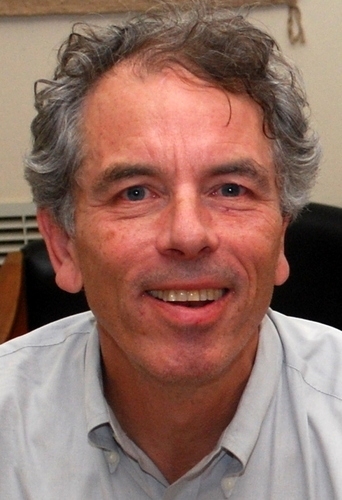
The Knight Science Journalism Program at MIT has announced that David Corcoran, longtime editor of Science Times, the weekly science section of The New York Times, will be joining the KSJ team as its first associate director. His tenure begins in July.
“We are thrilled to have David join the KSJ staff in such an important and visible role,” said program director and Pulitzer prizewinning science journalist Deborah Blum. “He brings with him an international reputation for excellence, emphasizing our mission of both supporting and illuminating the profession of science journalism."
In his capacity as associate director, Corcoran will play a pivotal role in helping to manage KSJ's acclaimed fellowship — an elite, mid-career program that lures prominent science journalists from around the world for nine months of study and intellectual exploration at MIT, Harvard University, and other area institutions. He will also assist in story development and serve as a senior editor and podcast host for KSJ's recently launched online science magazine, Undark — an expansion of the expertise he has already lent to the magazine on a freelance basis since its debut in late February.
Corcoran spent nearly 30 years at The New York Times, where he held a number of roles, including education editor and deputy op-ed editor. After joining the Times' science desk, he pioneered the successful Science Times podcast — an experience that led him to suggest launching a similar program for Undark. The magazine's editor and former KSJ fellow, Tom Zeller Jr., gladly took him up on the idea and made him host.
"David was the editor who gave me my first byline when I arrived at The New York Times as a cub reporter nearly 20 years ago," Zeller said. "I've seen and experienced his keen storytelling sensibilities, deft editing, and journalistic smarts first-hand, so I feel incredibly lucky that we'll have him in-house full-time as both a mentor for the fellows, and a hired hand on our new magazine."
Corcoran said his work with Undark helped to convince him that joining the program would be an excellent move.
“I was very impressed with the energy and commitment of Deborah and Tom to the new magazine, and they had me up to visit the fellowship program and speak to the fellows and I was very taken with them," Corcoran said, adding: "It just seemed like a great fit for me."
In addition to his work at The New York Times, Corcoran recently edited “The New York Times Book of Science," a compilation of 125 of the finest examples of newspaper science coverage culled from over 150 years of The New York Times' archives. Corcoran is also an avid runner and published poet, with work featured in both Podium and Barrow Street. Poetry, art, and visual storytelling are important to Corcoran — all reasons he says he felt drawn to KSJ and Undark.
“This is what we were trying to do with Science Times, is to make it a compelling experience in every way,” he said. “I was always very concerned with the photography and the illustrations and the graphics that we presented — they add so much value to a story.”
Corcoran plans to arrive in Cambridge in early July — just ahead of the mid-August arrival of a new crop of fellows, who are themselves descending on MIT from all four corners of the U.S., as well as France, Italy, Mexico, and Kenya.
“I can’t wait to get started," Corcoran said.