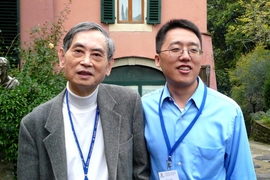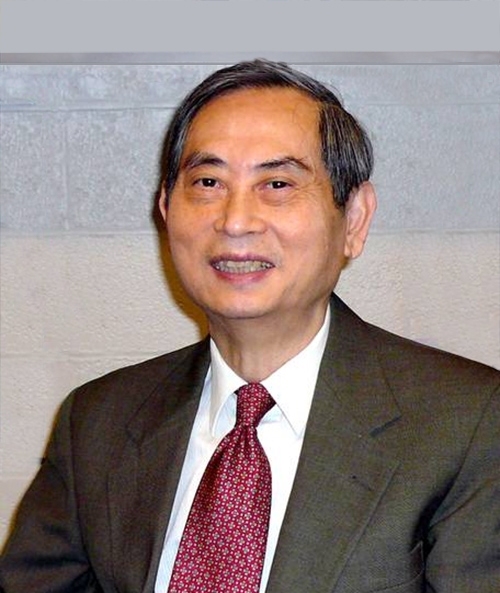
Sow-Hsin Chen, emeritus professor in the Department of Nuclear Science and Engineering (NSE) has been awarded the 2015 Guiner Prize. The prize, sponsored by the International Union of Crystallography, recognizes lifetime achievement, a major breakthrough, or an outstanding contribution to the field of small-angle scattering.
Over his 50-year career, Chen has made numerous original and novel contributions employing small-angle scattering in fundamental studies of soft condensed matter physics. He is one of the premier scientists and experts in the international scattering community. Hallmarks of his distinguished career include the development of new methods for data analysis, together with pioneering experiments on the structure and mutual interactions of self-assembled systems such as micelles, microemulsions, and protein-surfactant complexes in solution. He has trained a significant portion of the next generation of researchers in the field, including 45 PhD students. In addition, he has written a comprehensive textbook on scattering methods in complex fluids.
Chen will receive his prize from Professor Jill Trewhella, chair of the International Union of Crystallography Small-Angle Scattering Commission, and will present a plenary lecture on September 17 at the 16th International Conference on Small-Angle Scattering in Berlin.