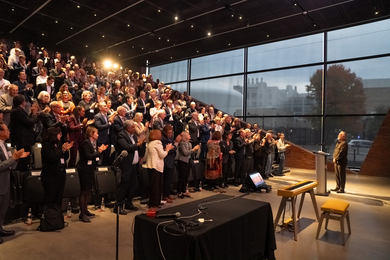
The new Institute for Data, Systems, and Society (IDSS) officially launches today at MIT. Spanning all five MIT schools and offering a range of cross-disciplinary academic programs, IDSS uses tools and methodologies in statistics, information and decision systems, and social sciences to address challenges and opportunities in complex systems. IDSS research encompasses a variety of domains, including finance, social networks, urbanization, energy systems, and health analytics.
Over the coming years, IDSS will support and develop academic programs advancing its mission. It will, for instance, offer the Doctoral Program in Social and Engineering Systems. IDSS also hosts the Technology and Policy Program (TPP), which has offered the Master of Science in Technology and Policy at MIT since 1976. Emphasizing the need to analyze data in order to make informed decisions, IDSS is working to offer academic programs in statistics to MIT’s undergraduate and graduate students.
IDSS director is Munther Dahleh, the William A. Coolidge Professor in the Department of Electrical Engineering and Computer Science (EECS). Associate directors are EECS Professor Asuman Ozdaglar, who is also director of the Laboratory for Information and Decision Systems, and Professor Ali Jadbabaie, a visiting professor from the University of Pennsylvania who is also interim director of the Sociotechnical Systems Research Center.
More information about IDSS and its mission, people, research, and academic programs can be found on the new IDSS website, idss.mit.edu.