Skip to content ↓

Terrascope students visit South Africa

Blog details Terrascope and NMMU students’ experiences as they delve into water issues in South Africa and around the world.
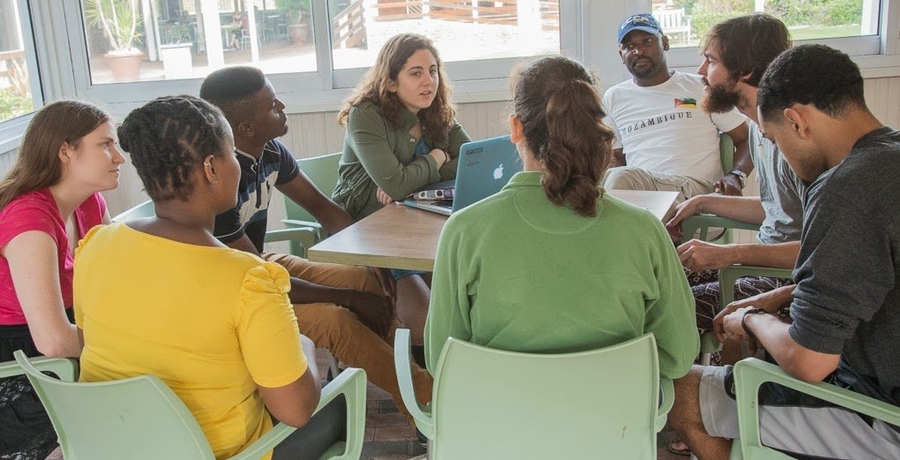
MIT and NMMU students discuss flooding and other water-related issues that affect the informal settlements around the Missionvale campus of NMMU.
Caption:
MIT and NMMU students discuss flooding and other water-related issues that affect the informal settlements around the Missionvale campus of NMMU.
Credits:
Photo: Vicki McKenna

Students in Terrascope, one of MIT's learning communities for first-year students, are spending their spring break in South Africa, getting a first-hand look at problems related to clean-water access there.

In the fall Terrascope project, Mission 2017, freshmen researched the global clean-water-access problem and proposed a series of possible solutions, which were then presented in a public forum, and critiqued by a panel of experts. The visit to South Africa is designed to extend their learning through first-hand experience of the many issues people face in gaining access to clean water.

This trip is the result of a relationship between the Terrascope program and the Earth Stewardship Science and AEON programs of Nelson Mandela Metropolitan University (NMMU) in South Africa. Students and staff from MIT and NMMU on the trip are engaging in discussion and debate that will hopefully lead to new ideas about how to deal with clean-water issues in southern Africa and around the world. Additionally, the trip aims to give students a deeper appreciation of different cultures and recent historical events, especially the apartheid legacy of South Africa and the role of Nelson Mandela.

The blog recording their experiences can be found at http://terrascopetrip2017.blogspot.com
Related Links

Related Topics

More MIT News

Globular blue and white orbs "examining" single-stranded RNA products and marking them with green checks or red x's

Why are some bacterial genes high in purines?

In certain species of bacteria, the answer lies in shielding RNA transcripts from a quality-control factor called Rho. Understanding the requirements for expressible sequences is critical for expression engineering of therapeutic agents.

Read full story

Rich Nielsen, Volha Charnysh, Kevin Dorst, and Emily Richmond Pollock seated at a table, talking

Building a scholarly community

The SHASS Faculty Fellows Program, administered by the MIT Human Insight Collaborative, is fostering new research projects and creating space for supportive and interdisciplinary discussion.

Read full story