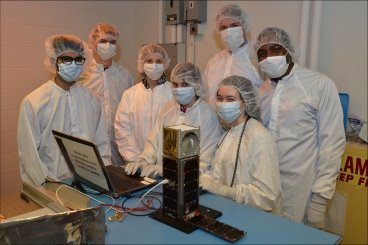
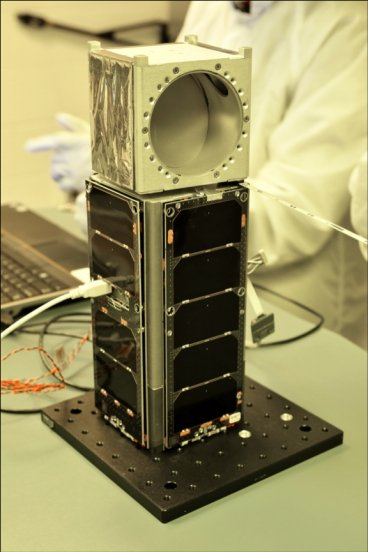
With its planned launch just about six weeks away, MicroMAS is ready for its closeup. MicroMAS (Micro-sized Microwave Atmospheric Satellite) is a three-unit CubeSat developed by MIT's Space Systems Laboratory that integrates a single-unit microwave radiometer payload from MIT's Lincoln Laboratory with a three-axis stabilized two-unit CubeSat bus. The project is being built and developed by a team led by Kerri Cahoy, Boeing Assistant Professor of Aeronautics and Astronautics at MIT.
On March 21, following seven months of flight integration and environmental testing at MIT Lincoln Laboratory, Cahoy and her team delivered MicroMAS to NanoRacks, a Houston-based commercial launch provider. The system is projected to launch to the International Space Station on May 6, with deployment from the ISS into orbit sometime in May or June.
The payload is a multispectral passive microwave radiometer that collects observations in the 118 GHz range. This complements existing on-orbit radiometer capability delivered by larger systems that also operate in other spectral bands.
MicroMAS is expected to provide unprecedented observations of the dynamics of hurricanes and other large storm systems. It should also feature significantly improved revisit times, while delivering resolution comparable to that of to larger, much costlier polar-orbiting satellites.
The MicroMAS team hopes the implementation of this atmospheric science mission using low-cost commercial components and the standard CubeSat launch vehicle interface will demonstrate the significant advantage that using a distributed set of CubeSats for future meteorological satellites can have over the traditional satellite architecture. By enabling the persistent collection of data from multiple low-cost distributed platforms, new system designs based on the MicroMAS mission can be expected to greatly improve operational numerical weather predictions, climate records, and other scientific objectives.