Skip to content ↓

Gedik and Jarillo-Herrero named 2014 Moore Experimental Investigators in Quantum Materials

The professors have been awarded $1.8 million each for discovery-driven, high-risk research, with potential for new experimental techniques.
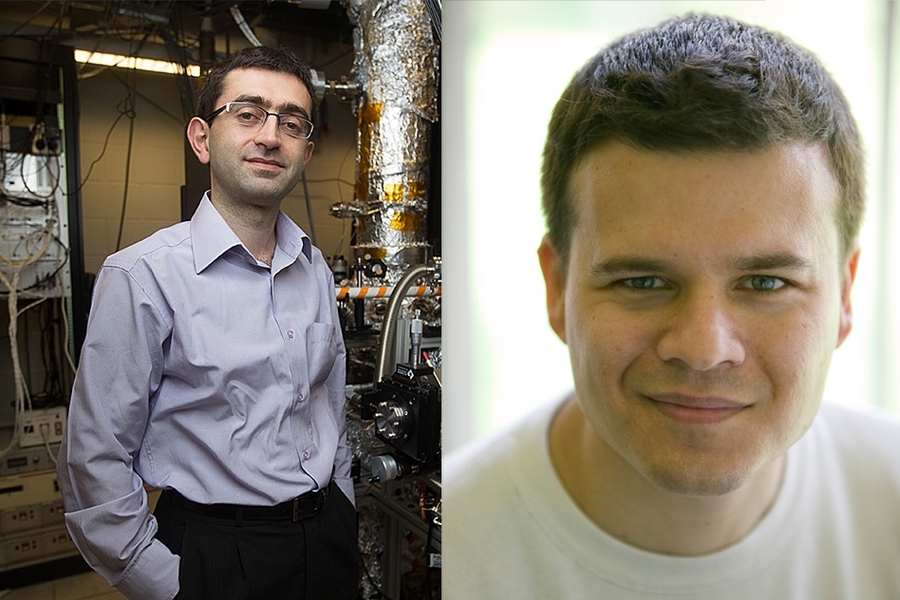
Nuh Gedik and Pablo Jarillo-Herrero
Caption:
Nuh Gedik and Pablo Jarillo-Herrero
Credits:
Photos: Bryce Vickmark (Gedik) and Justin Knight (Jarillo-Herrero)

Nuh Gedik, the Lawrence C. (1944) and Sarah W. Biedenharn Career Development Associate Professor of Physics, and Pablo Jarillo-Herrero, the Mitsui Career Development Associate Professor of Physics, have been named Experimental Investigators in Quantum Materials by the Gordon and Betty Moore Foundation.

The two are among 19 winners nationwide of the foundation's Emergent Phenomena in Quantum Systems (EPiQS) Initiative. Each will receive a five-year, $1.8 million grant to support their research in experimental condensed matter physics.

Gedik’s research centers on using advanced optical techniques for probing and controlling properties of quantum materials, such as topological insulators and high-temperature superconductors.

Jarillo-Herrero concentrates on quantum electronic transport and optoelectronics in novel, low-dimensional materials, such as graphene, transition metal dichalcogenides, and topological insulators.

The EPiQS Initiative of the Gordon and Betty Moore Foundation aims to stimulate experimental research in the physics of quantum materials by providing some of the field’s most creative scientists with freedom to take risks and flexibility for agile change of research direction.
Related Links

Related Topics

Related Articles

More MIT News

Rich Nielsen, Volha Charnysh, Kevin Dorst, and Emily Richmond Pollock seated at a table, talking

Building a scholarly community

The SHASS Faculty Fellows Program, administered by the MIT Human Insight Collaborative, is fostering new research projects and creating space for supportive and interdisciplinary discussion.

Read full story

Globular blue and white orbs "examining" single-stranded RNA products and marking them with green checks or red x's

Why are some bacterial genes high in purines?

In certain species of bacteria, the answer lies in shielding RNA transcripts from a quality-control factor called Rho. Understanding the requirements for expressible sequences is critical for expression engineering of therapeutic agents.

Read full story