Skip to content ↓

Transition metal oxide catalysts

Hong works to map dynamic oxidation reactions
MIT materials science graduate student Wesley T. Hong in the lab.
Caption:
MIT materials science graduate student Wesley T. Hong in the lab.
Credits:
Photo: Denis Paiste/Materials Processing Center
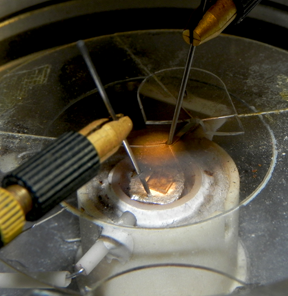
A lanthanum strontium cobaltite (LSC113) thin film in preparation for electrochemical impedance spectroscopy testing. The setup allows for measurement of a sample's oxygen surface exchange kinetics at high temperature and controlled atmosphere.
Caption:
A lanthanum strontium cobaltite (LSC113) thin film in preparation for electrochemical impedance spectroscopy testing. The setup allows for measurement of a sample's oxygen surface exchange kinetics at high temperature and controlled atmosphere.
Credits:
Photo: Denis Paiste/Materials Processing Center
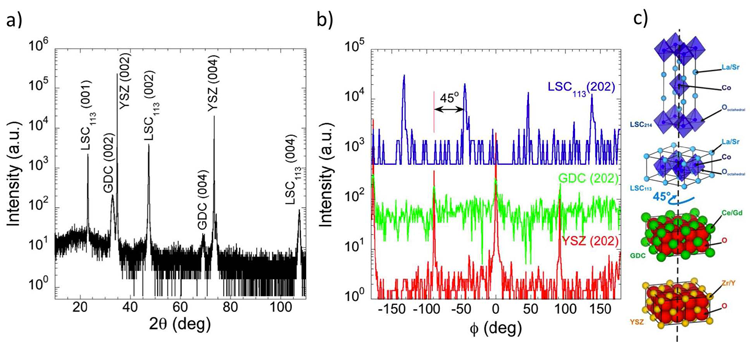
Schematic charts heating of lanthanum strontium cobaltite thin film (LSC) results in reconfiguration of the LSC molecule. (a) Representative normal X-ray diffraction data of 90 nm LSC113 or 90 nm LSC113/214 films, (b) representative off-normal XRD phi scan. (c) Schematic of the crystallographic rotational relationships among the LSC214(001)tetragonal, LSC113(001)pc, GDC(001)cubic, and YSZ(001)cubi...
Caption:
Schematic charts heating of lanthanum strontium cobaltite thin film (LSC) results in reconfiguration of the LSC molecule. (a) Representative normal X-ray diffraction data of 90 nm LSC113 or 90 nm LSC113/214 films, (b) representative off-normal XRD phi scan. (c) Schematic of the crystallographic rotational relationships among the LSC214(001)tetragonal, LSC113(001)pc, GDC(001)cubic, and YSZ(001)cubic. Image at right illustrates the different crystallographies of LSC113 vs. LSC214. In situ XRD was performed on 90 nmLSC113 and 90 nm LSC113/214 at room temperature, 220 and 350 degrees Celsius, and 400 degrees Celsius (only for 90 nm LSC113) in ambient air.
Credits:
Image: <i>Journal of Physical Chemistry Letters</i>

Related Links

Related Topics

More MIT News

Globular blue and white orbs "examining" single-stranded RNA products and marking them with green checks or red x's

Why are some bacterial genes high in purines?

In certain species of bacteria, the answer lies in shielding RNA transcripts from a quality-control factor called Rho. Understanding the requirements for expressible sequences is critical for expression engineering of therapeutic agents.

Read full story

Rich Nielsen, Volha Charnysh, Kevin Dorst, and Emily Richmond Pollock seated at a table, talking

Building a scholarly community

The SHASS Faculty Fellows Program, administered by the MIT Human Insight Collaborative, is fostering new research projects and creating space for supportive and interdisciplinary discussion.

Read full story