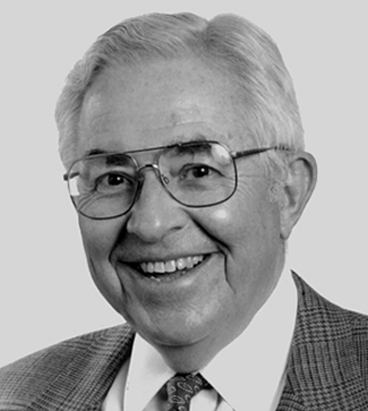
Leonard A. Gould, an alumnus and emeritus professor in the Department of Electrical Engineering and Computer Science died on Saturday, Sept. 8. He was 85.
Gould, who received his SB and ScD from MIT in 1948 and 1953 respectively, became a member of the MIT faculty in 1953 and retired in 1997. His research interests included control problems and dynamic modeling in industrial systems (chemical, nuclear, electrical power and rotating machinery), sampled-data control systems, adaptive estimation and the time series analysis of financial data.
Gould worked through the 1940s and '50s in the area of process control as applied to the solution of chemical control problems. His book, "Chemical Process Control," was published in 1969.
As associate director of the Electronic Systems Laboratory (ESL), previously known as the MIT Servomechanisms Laboratory, from 1971 to 1976, Gould continued his interest in advanced feedback-control theory. Under Gould's leadership, the ESL provided a new cooperative focus on research and education between staff and students from MIT's Department of Chemical Engineering and his group in electrical engineering.
Gould was a fellow of the IEEE since 1973. As a frequent consultant to industry on a wide range of control applications, Gould published many technical articles in that field.
He is survived by his wife, Emma, of Dedham; nephew, Neal Spevack, of New York; and Sue Graze of Austin, Texas. Graveside services were held on Tuesday, Sept. 11, at the Beit Olam Cemetery in Wayland, Mass.
Gould, who received his SB and ScD from MIT in 1948 and 1953 respectively, became a member of the MIT faculty in 1953 and retired in 1997. His research interests included control problems and dynamic modeling in industrial systems (chemical, nuclear, electrical power and rotating machinery), sampled-data control systems, adaptive estimation and the time series analysis of financial data.
Gould worked through the 1940s and '50s in the area of process control as applied to the solution of chemical control problems. His book, "Chemical Process Control," was published in 1969.
As associate director of the Electronic Systems Laboratory (ESL), previously known as the MIT Servomechanisms Laboratory, from 1971 to 1976, Gould continued his interest in advanced feedback-control theory. Under Gould's leadership, the ESL provided a new cooperative focus on research and education between staff and students from MIT's Department of Chemical Engineering and his group in electrical engineering.
Gould was a fellow of the IEEE since 1973. As a frequent consultant to industry on a wide range of control applications, Gould published many technical articles in that field.
He is survived by his wife, Emma, of Dedham; nephew, Neal Spevack, of New York; and Sue Graze of Austin, Texas. Graveside services were held on Tuesday, Sept. 11, at the Beit Olam Cemetery in Wayland, Mass.