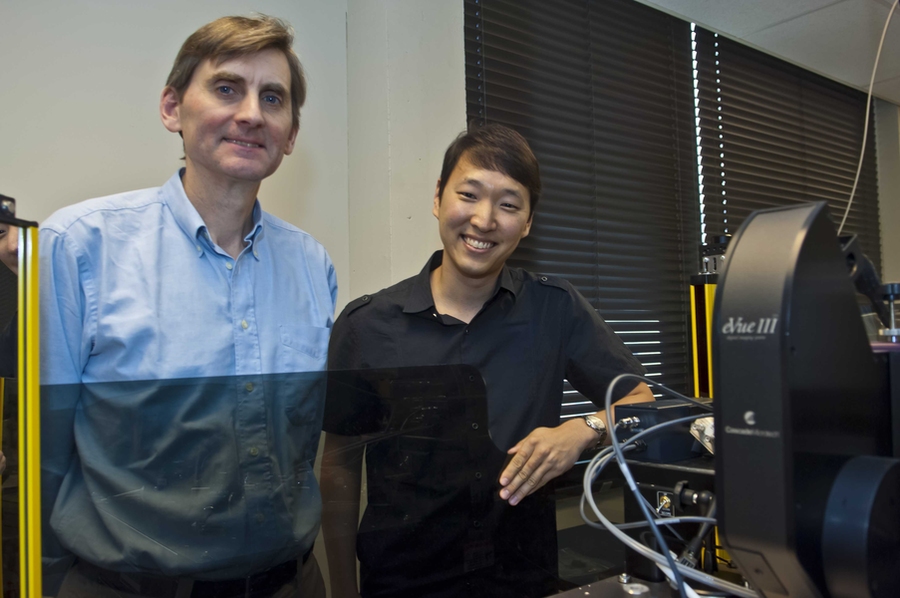
Electrical engineering and computer science graduate student Donghyun Jin was awarded the ISPSD ’12 Charitat Award-Runner-up at the 24th IEEE International Symposium on Power Semiconductor Devices and ICs (ISPSD), which took place June 3-7 in Bruges, Belgium. Jin was cited for a paper titled “Mechanisms responsible for dynamic ON-resistance in GaN high-voltage HEMTs.”
Jin is a graduate student in Jesús del Alamo’s research group at the Microsystems Technology Laboratories at MIT. His research is motivated by the global interest and need for a new generation of ultra-efficient power transistors for electrical power management. Gallium nitride (GaN) is a semiconductor material with a wide band gap, affording it special properties for optoelectronics, high-power and high-frequency device applications. GaN transistors are being investigated for a new generation of electrical power management systems in everyday electronics such as personal computers, home appliances and electric cars. Worldwide energy demand continues to drive the need for far greater efficiency in all of these applications.
Jin’s research examines a significant problem in GaN transistors: When the transistor is switched on and off quickly, as in a power management application, the performance degrades. A crucial attribute in a power transistor is the so-called ON resistance, which burns unnecessary power and diminishes the efficiency of the transistor. Ideally, the ON resistance should be very small. In GaN transistors, the ON resistance can become quite high for a short period of time when the device is switched on rapidly.
Jin’s research goal was to study the origin of this phenomenon, thereby finding ways to minimize this problem. Jin developed a new measuring technique to diagnose the ON resistance on a very short time scale — nanoseconds or microseconds — and then to track its evolution over long periods of time (up to hours) as the device relaxes after the switching event. By doing this study as a function of temperature and other conditions, Jin has been able to postulate an origin for this phenomenon that could that could lead to a solution to this problem. Jin’s experiments provide the first systematic study of the dynamics of the ON resistance in GaN transistors after a switching event.
Jin is a graduate student in Jesús del Alamo’s research group at the Microsystems Technology Laboratories at MIT. His research is motivated by the global interest and need for a new generation of ultra-efficient power transistors for electrical power management. Gallium nitride (GaN) is a semiconductor material with a wide band gap, affording it special properties for optoelectronics, high-power and high-frequency device applications. GaN transistors are being investigated for a new generation of electrical power management systems in everyday electronics such as personal computers, home appliances and electric cars. Worldwide energy demand continues to drive the need for far greater efficiency in all of these applications.
Jin’s research examines a significant problem in GaN transistors: When the transistor is switched on and off quickly, as in a power management application, the performance degrades. A crucial attribute in a power transistor is the so-called ON resistance, which burns unnecessary power and diminishes the efficiency of the transistor. Ideally, the ON resistance should be very small. In GaN transistors, the ON resistance can become quite high for a short period of time when the device is switched on rapidly.
Jin’s research goal was to study the origin of this phenomenon, thereby finding ways to minimize this problem. Jin developed a new measuring technique to diagnose the ON resistance on a very short time scale — nanoseconds or microseconds — and then to track its evolution over long periods of time (up to hours) as the device relaxes after the switching event. By doing this study as a function of temperature and other conditions, Jin has been able to postulate an origin for this phenomenon that could that could lead to a solution to this problem. Jin’s experiments provide the first systematic study of the dynamics of the ON resistance in GaN transistors after a switching event.