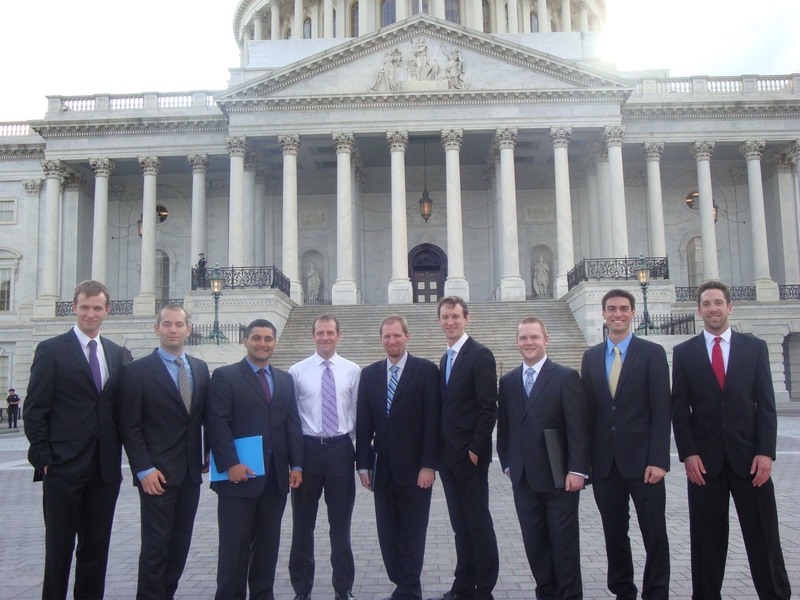
Eleven MIT fusion science students met with more than 26 Senate and House offices on June 14. They expressed concern over legislation in the Senate Appropriations Committee that threatens funding for the domestic fusion program, including the shutdown and dismantling of the Alcator C-Mod tokamak at MIT and significant reductions in support for U.S. fusion graduate students and postdocs.
Grad student Zach Hartwig, who helped organize the trip, characterized the meetings as "extremely productive but only the first steps in a longer-term advocacy effort in support of the fusion energy sciences."
Bipartisan support for the domestic fusion program was expressed by staff from numerous Senate offices, including Massachusetts Senators John Kerry (D-Mass.) and Scott Brown (R-Mass.), who have previously written letters of support for fusion and have agreed to continue working with the fusion community on the issue. The MIT students attending the congressional visits spoke of the preparation and meetings as a terrific learning experience in science advocacy and an insightful glimpse into the politics of federally funded science.
MIT students Harold Barnard (NSE, G), Dan Brunner (NSE, G),Evan Davis (physics, G),Ian Faust (NSE, G), Mike Garrett (AeroAstro, G), Christian Haakonsen (NSE, G), Zach Hartwig (NSE, G), Nathan Howard (NSE, G), Bob Mumgaard (NSE, G), Brandon Sorbom (NSE, G) and John Walk (NSE, G) were joined by undergraduate Taylor Ratliff from the University of Texas at Austin, who is involved in fusion research on Alcator C-Mod.
Grad student Zach Hartwig, who helped organize the trip, characterized the meetings as "extremely productive but only the first steps in a longer-term advocacy effort in support of the fusion energy sciences."
Bipartisan support for the domestic fusion program was expressed by staff from numerous Senate offices, including Massachusetts Senators John Kerry (D-Mass.) and Scott Brown (R-Mass.), who have previously written letters of support for fusion and have agreed to continue working with the fusion community on the issue. The MIT students attending the congressional visits spoke of the preparation and meetings as a terrific learning experience in science advocacy and an insightful glimpse into the politics of federally funded science.
MIT students Harold Barnard (NSE, G), Dan Brunner (NSE, G),Evan Davis (physics, G),Ian Faust (NSE, G), Mike Garrett (AeroAstro, G), Christian Haakonsen (NSE, G), Zach Hartwig (NSE, G), Nathan Howard (NSE, G), Bob Mumgaard (NSE, G), Brandon Sorbom (NSE, G) and John Walk (NSE, G) were joined by undergraduate Taylor Ratliff from the University of Texas at Austin, who is involved in fusion research on Alcator C-Mod.