Nuclear fusion is a seemingly ideal energy source: carbon-free, fuel derived largely from seawater, no risk of runaway reactors and minimal waste issues. With the world’s energy supply chain facing intense environmental, economic and political pressures, fusion’s appeal is growing and international collaboration is accelerating. And the MIT Department of Nuclear Science and Engineering’s (NSE) long-standing fusion program is extending its leadership role in advancing the technology toward practical use.
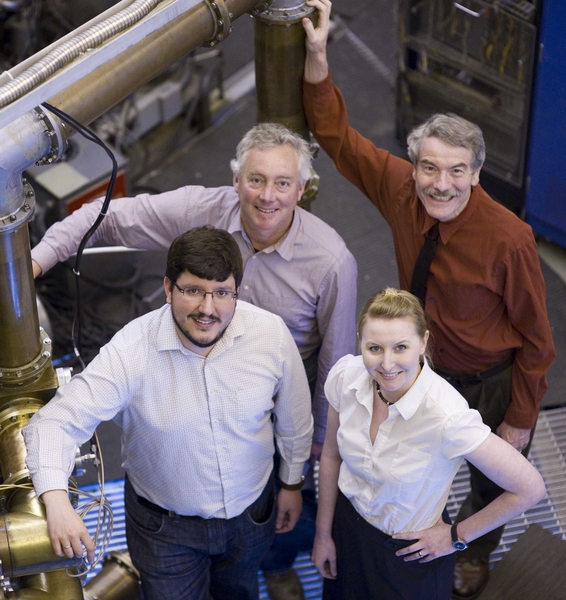
NSE’s Plasma Science and Fusion Center (PFSC), home of one of just three U.S. tokamak fusion reactors, has been a focal point of fusion research since its founding in 1976, developing substantial basic knowledge about creating and maintaining fusion reactions. And today, explains Professor Dennis Whyte, NSE’s fusion team is beginning a strategic pivot into the next stage of development, with a focus on interdisciplinary knowledge needed for the creation of functioning powerplants.
Fusion reactors, such as PFSC’s ALCATOR C-Mod, rely on the same mechanism that powers stars — collisions between atomic nuclei at extremely high temperatures (more than 100 million degrees). At those temperatures, the natural repellence of nuclei to one another is sometimes overcome, allowing them to fuse. Hydrogen isotopes deuterium and tritium, the leading fuel candidates, ionize into a plasma when heated; their fusion creates a helium isotope and a neutron, while releasing nuclear energy.
“We’re basically making energy by creating a star,” explains Whyte. “For power generation, the star has to turn on, and stay on for a year at a time, and we need a way to extract the energy it creates.”
Read full article
NSE’s Plasma Science and Fusion Center (PFSC), home of one of just three U.S. tokamak fusion reactors, has been a focal point of fusion research since its founding in 1976, developing substantial basic knowledge about creating and maintaining fusion reactions. And today, explains Professor Dennis Whyte, NSE’s fusion team is beginning a strategic pivot into the next stage of development, with a focus on interdisciplinary knowledge needed for the creation of functioning powerplants.
Fusion reactors, such as PFSC’s ALCATOR C-Mod, rely on the same mechanism that powers stars — collisions between atomic nuclei at extremely high temperatures (more than 100 million degrees). At those temperatures, the natural repellence of nuclei to one another is sometimes overcome, allowing them to fuse. Hydrogen isotopes deuterium and tritium, the leading fuel candidates, ionize into a plasma when heated; their fusion creates a helium isotope and a neutron, while releasing nuclear energy.
“We’re basically making energy by creating a star,” explains Whyte. “For power generation, the star has to turn on, and stay on for a year at a time, and we need a way to extract the energy it creates.”
Read full article