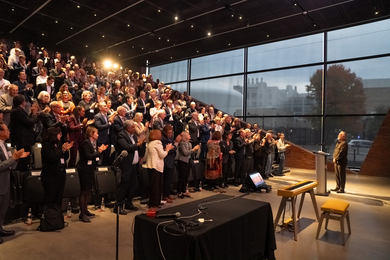
The recent White House press conference looked a little like an MIT reunion — but its purpose was to announce the new National Science Foundation (NSF) Career-Life Balance Initiative, a 10-year plan to provide greater work-related flexibility to women and men in research careers.
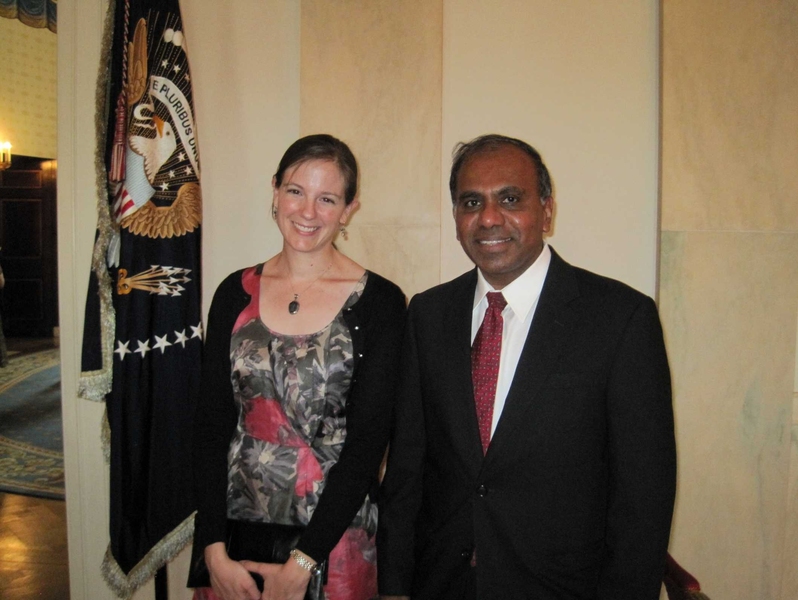
The announcement was made Sept. 26 by White House Office of Science and Technology Policy Director John P. Holdren ’65, SM ’66; National Science Foundation Director Subra Suresh ScD ’81, former dean of the MIT School of Engineering; and a White House official.
The policy effort was spurred by a young scientist who was the first NSF Postdoctoral Fellow to use a no-cost extension of a fellowship for maternity leave — earth scientist Trish Gregg PhD ’08.
“This inspired my NSF program director to ask what practices were in place to aid early career scientists during these exciting life moments," Gregg says. "And because of this, the NSF Postdoctoral solicitation and many of the CAREER grant solicitations now have specific language allowing scientists (male or female) to request no-cost extension and extended start dates for family leave. This is just one excellent example of the exciting work that is being done.”
Read the Slice of MIT blog post to learn about the new policy and about Gregg’s current research.
The announcement was made Sept. 26 by White House Office of Science and Technology Policy Director John P. Holdren ’65, SM ’66; National Science Foundation Director Subra Suresh ScD ’81, former dean of the MIT School of Engineering; and a White House official.
The policy effort was spurred by a young scientist who was the first NSF Postdoctoral Fellow to use a no-cost extension of a fellowship for maternity leave — earth scientist Trish Gregg PhD ’08.
“This inspired my NSF program director to ask what practices were in place to aid early career scientists during these exciting life moments," Gregg says. "And because of this, the NSF Postdoctoral solicitation and many of the CAREER grant solicitations now have specific language allowing scientists (male or female) to request no-cost extension and extended start dates for family leave. This is just one excellent example of the exciting work that is being done.”
Read the Slice of MIT blog post to learn about the new policy and about Gregg’s current research.