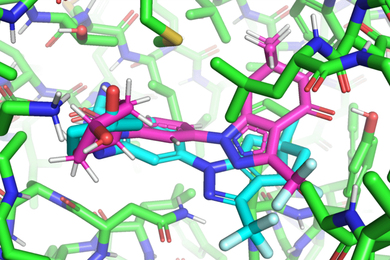
Artificial intelligence model finds potential drug molecules a thousand times faster
A geometric deep-learning model is faster and more accurate than state-of-the-art computational models, reducing the chances and costs of drug trial failures.
A geometric deep-learning model is faster and more accurate than state-of-the-art computational models, reducing the chances and costs of drug trial failures.

Researchers created Exo for writing high-performance code on hardware accelerators.

The brilliant scientist was known for both the depth of his intellect and his kindness.

Rapid increases in the speed and power of microchips have fueled innovation in many industries, but the future trajectory of that incredible progress may be in jeopardy.

MIT alumni-founded Overjet analyzes and annotates dental X-rays to help dentists offer more comprehensive care.
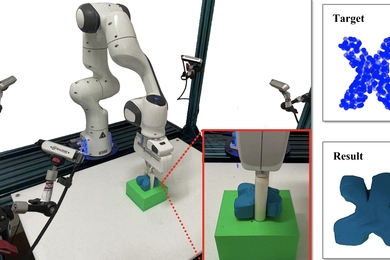
A new system lets robots manipulate soft, deformable material into various shapes from visual inputs, which could one day enable better home assistants.
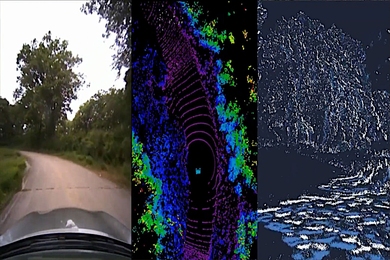
MIT scientists unveil the first open-source simulation engine capable of constructing realistic environments for deployable training and testing of autonomous vehicles.
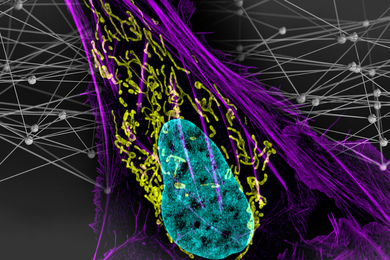
The system rapidly scans the genome of cancer cells, could help researchers find targets for new drugs.
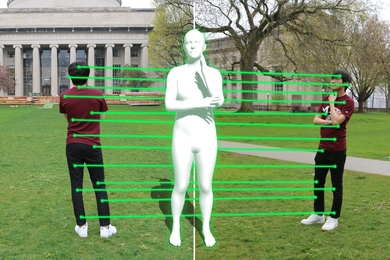
A new technique in computer vision may enhance our three-dimensional understanding of two-dimensional images.
The five-year collaboration aims to accelerate the translation of breakthrough engineering and biology for human health.

CSAIL scientists’ novel hardware attack against the Apple M1 chip defeats the last line of security while leaving no trace.
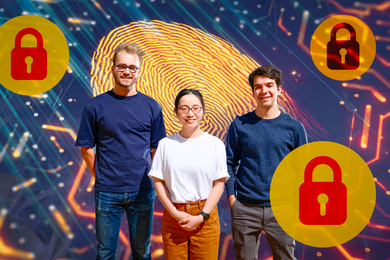
Studying a powerful type of cyberattack, researchers identified a flaw in how it’s been analyzed before, then developed new techniques that stop it in its tracks.

MIT professor will leverage his research into machine learning and computer science, as well as his role as a practicing cardiologist, toward educating clinician-scientists and engineers.

Researchers developed a new system that can make computer programs run faster, while guaranteeing accuracy.

A machine-learning method imagines what a sentence visually looks like, to situate and ground its semantics in the real world, improving translation, like humans can.