Skip to content ↓

📬 Want a dose of MIT in your inbox? Subscribe to the MIT Daily and/or MIT Weekly newsletters.

Top News

Looking for audio? Listen to the MIT News podcast →

Recent Highlights

More MIT News articles

In the Media

STAT

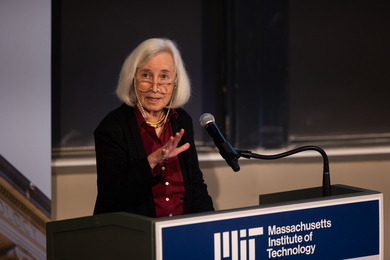
At the STAT Summit, President Sally Kornbluth joined Holden Thorp, editor-in-chief of the Science family of journals, for a panel moderated by STAT’s Anil Oza. During the conversation, Kornbluth emphasized the importance of curiosity-driven research and education at institutions like MIT, highlighting MIT for America, a new initiative aimed at ensuring learners and educators from Kindergarten through community college across the country have access to STEM education. “We want to both meet people where they are, give their kids the opportunity, and also make them understand us as people who care about their communities,” says Kornbluth.

Metropolis

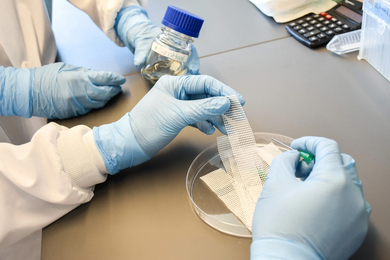
Metropolis reporter Anthony Paletta details how MIT’s inaugural Future Fest “brought together visionary leaders across design, technology, and art to address the world’s most pressing problems,” and also featured the public debut of the redesigned Metropolitan Warehouse. The festival featured discussions, exhibits and demonstrations on architecture, design and technology, including a new technique that utilizes knitted fibers as a flexible formwork for concrete, a discussion on how AI could be used to increase sustainability in construction and exploration of how “reef legos” can rebuild beaches and combat costal erosion. “There are no shortage of things going wrong in the world, and others likely to follow,” writes Paletta, “but MIT’s Future Fest offered reassuring proof that we’ve not run out of means to address these problems.” 

TechCrunch

After observing the behavior of 13 AI agents on a simulated desert island, MIT researchers suggest that allowing agents to explore “without a goal” could be an effective way to teach AI agents new skills, reports Aditya Mehta for TechCrunch. “We normally develop artificial agents by deciding in advance what they should practice, what they should optimize, and what counts as progress,” the researchers write. “Play suggests another regime: give an agent a sufficiently rich and safe world, let it choose what is interesting, and allow useful knowledge to accumulate from the history that follows.” 

WBUR

Prof. Tod Machover speaks to WBUR’s Andrea Shea about “already and not yet” an interactive composition he wrote for the Boston Symphony Orchestra and an AI instrument developed by Machover and graduate student Manaswi Mishra. Machover explains that they designed the AI tools so that they’re “always going to make a kind of variation, a coloration, an extension of what the musician's playing – but exactly what it's going to do I do not have complete control over. I'm trying to show that it [AI] can be integrated in a beautiful, provocative and interesting way in a serious piece of music.”  

TechCrunch

Flapping Airplanes, a startup co-founded by Benjamin Spector ’22, MEng ’22, has developed a framework for AI models to run efficiently while being trained on less data and in a single graphics processing unit (GPU), writes Julie Bort for TechCrunch. The framework “can run a task that spends most of its time waiting for data to be fetched alongside one that spends most of its time doing math, so the chip is rarely sitting idle,” notes Bort. “The premise is that AI has barely scratched the surface of what GPUs can do, and they believe it can create intelligent systems ‘without ingesting half the internet.’”  

Fox Business

Prof. Daron Acemoglu joins “The Claman Countdown” on Fox Business to discuss the possibility that largescale deployment of AI could triple unemployment within the next decade. “There is so much uncertainty about AI,” says Acemoglu. “It’s very difficult to know exactly when we’re going to see the productivity gains, which will come, and when we’re going to see job losses, and whether we’ll actually see some job creation as well. But on the current path where AI is being prepared and developed as a labor replacing technology, I would be very worried that within the next ten years we’ll see a lot of jobs disappear.”  

El Pais

Postdoctoral Associate Iman YeckehZaare speaks to El País reporter Jordi Pérez Colomé about his research on RentAHuman, a platform that allows AI agents to hire people to do physical labor. “RentAHuman has shown that many people are willing to sign up to be hired by AI agents. What it still hasn’t shown is that many AI agents are doing the hiring,” says YeckehZaare. “Listings posted by agents will increase as AI agents become capable of acting and paying on their own.”  

Poets&Quants

Poets & Quants reporter Jeff Schmitt writes that MIT Sloan School of Management’s Assistant Dean Dawna Levenson has been honored as the “MBA Admissions Director of the Year,” by Poets & Quants. “Dawna brings a very human-first approach to MIT Sloan Admissions, deeply learning about our applicants as people and professionals, getting to know them through interviews, and understanding how they hope to make a difference in the world through their education,” says Sloan Dean Richard Locke. “She supports students throughout the admissions journey, providing guidance, helping them navigate the process, and pivoting, as needed, to support their matriculation.”  

The Street

Testing 1,000 synthetically generated client profiles against AI chatbots for investment advice, Prof. Andrew Lo and Research Affiliate Jillian Ross identified “heuristic collapse,” where chatbots based their recommendations almost entirely on self-reported risk tolerance, while ignoring income and other variables, writes Damilola Esebame for The Street. “Lo has recommended that investors use chatbots for orientation, leveraging them to frame questions, map out available options, and prepare for conversations with a human advisor rather than treating the output as a finished plan,” notes Esebame. 

TechCrunch

Eka Robotics, a startup cofounded by Prof. Pulkit Agrawal, has developed a robot with  a force-sensitive gripper that can “pick up about 1,500 objects that weigh up to 1 kg in an hour, compared to about 600 for a human” with 95% accuracy, reports Tim Fernholz for TechCrunch.  “We are starting off being very pragmatic, and saying here are two verticals in pick, arrange, place, and wire handling, let’s make them be home runs,” says Agrawal. “Once we have made home runs on them, the sky is the limit in how much we can do with the approach we are developing.” 

WDIY

Prof. Justin Reich joins WDIY’s Aryash Shyam, host of “Teen Scientist,” to discuss the use of AI tools in K-12 education. “In my classroom, everything we do with AI has been negotiated with students. I think that every educator in their own classroom can have an ongoing engagement [with students about AI use],” says Reich. “Historically, student tech teams have been very successful in many schools doing a wide range of things, helping to set policy, helping to provide professional development [and] helping give a sense of youth perspective.” 

The New Yorker

The New Yorker’s Gideon Lewis-Kraus details how Morris Chang ’52, SM ’53 founded the Taiwan Semiconductor Manufacturing Company (TSMC), “one of the most valuable tech companies globally” that “makes almost all of the world’s advanced [computer] chips.” “Chang proposed a semiconductor ‘foundry,’ which would do for pricey chips what its predecessors had done for cheap junk. At the time, however, the market didn’t exist,” writes Lewis-Kraus. “By the end of TSMC’s first decade, the company was bringing in a billion dollars in annual revenue.”  

Community Updates

Featured Multimedia

Video thumbnail

Alex Slocum, the Walter M. and A. Hazel May Professor of Mechanical Engineering at MIT, has a serious message for students in Fundamentals of Precision Product Design, but a famously fun way of delivering it. Students describe the course as “creative chaos,” an approach that drives home the importance of precision and repeatability in engineering design.

Video thumbnail

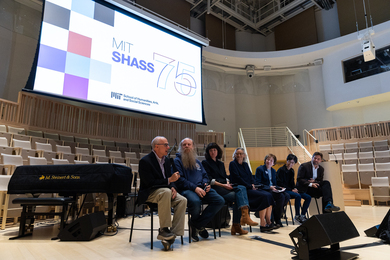
Founded in 1950, MIT’s School of Humanities, Arts, and Social Sciences encourages students to think broadly about the world and their place in it, while examining what it means to be human and the social, ethical, and economic dimensions of today’s greatest challenges.

Video thumbnail

Drawing on research he began at MIT, AJ Perez ’13, MEng ’14, PhD ’23, is finding new uses for the world’s growing plastic waste. His company, Atlas, 3D prints building materials from recycled plastic, giving discarded material a new purpose.

Video thumbnail

A fast-paced look at the people, ideas, research, and experiences that make MIT what it is. From groundbreaking discoveries and hands-on learning to a vibrant campus community, see the curiosity, creativity, and innovation that drive the Institute. This is MIT.

Video thumbnail

Meet Paula Hammond, MIT Institute Professor and Dean of the School of Engineering—the first woman and first Black scholar to lead MIT's Department of Chemical Engineering. Discover how her pioneering research in nanotechnology and ovarian cancer has shaped her career, the barriers she broke along the way, and what it means to change what leadership looks like in STEM.

More News