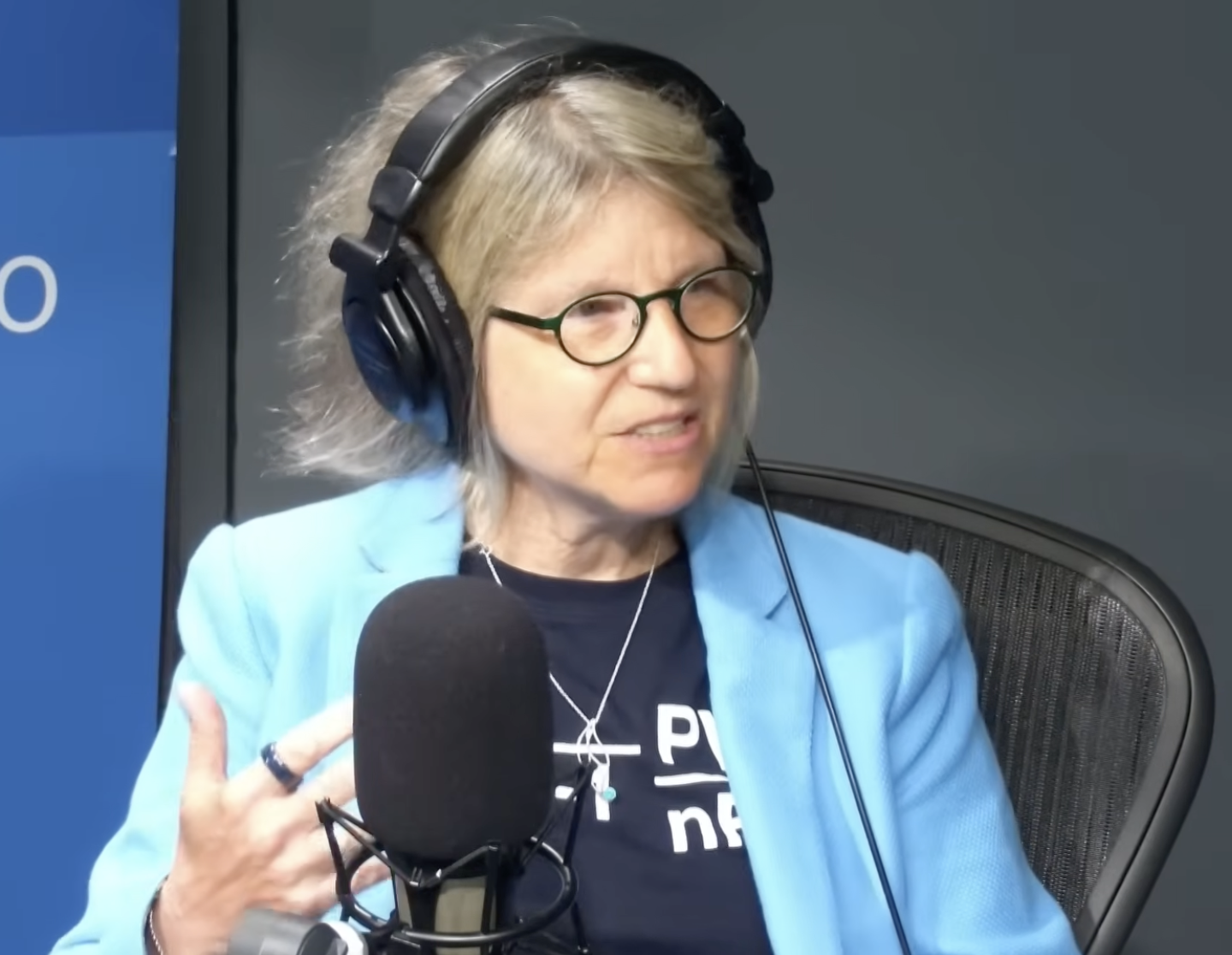
President Sally Kornbluth took to GBH’s “Boston Public Radio” (BPR) to discuss the value of scientific research amid cuts to federal funding and the new endowment tax impacting MIT and other universities. In her wide-ranging conversation with hosts Jim Braude and Margery Eagan, Kornbluth highlighted ‘Curiosity on a mission,’ MIT’s support for quantum technology, artificial intelligence and research—and where to get soft serve ice cream.
“The best science is scientists just following their instincts, trying to find the answers to fundamental questions,” said Kornbluth.
Scientific discovery is born from a long sequence of experiments, funded largely by federal grants, “but it's not just scientists doing [research] for their own sake,” she explains. “It's all these discoveries on a mission to do important things in the world, whether it's curing diseases or finding new materials or finding new ways to construct buildings.”
Currently, MIT has seen a 20% decline in federal funding, limiting graduate admissions and threatening future breakthroughs. Kornbluth emphasized, “[Researchers] have to go down a lot of blind alleyways following your curiosity to hit the things that are going to have major impact down the road.”
Kornbluth also touched on the impact of the endowment tax on MIT. “We've had to make a lot of budgetary cuts to accommodate the endowment tax and the losses in federal funding, so if you put it together, people have really had to tighten their belts…and really focus to keep our research mission,” she said.
The consequences of restricting research now may be felt a decade later.
Referencing the impacts of long-term research free from short-term pressures of politics and profit, Kornbluth mentioned Prof. Robert Weinberg’s discovery that RAS genes can mutate into many different cancers, including pancreatic cancer. “It's now been shown that RAS could be druggable,” explained Kornbluth. “So, this discovery that was made by Bob 45 years ago is now being translated into RAS targeting drugs that could lead to treatments of cancers like pancreatic cancer.”
Future treatments for cancer, and other diseases, are based on the discoveries made today. “If you look at some of the stuff like immunotherapy for cancer now, that was 40, 50, years of immunology research,” said Kornbluth. “People might not see the impact [of funding cuts] immediately, but you're going to see the impact in 10 years, and your children and your children's children will see the impact.”
Restrictions by the government are not limited to funding cuts. About 40% of MIT’s graduate student population are international students. Kornbluth explained to the hosts how the four-year cap on student visas by the Trump administration is incompatible with the amount of time it takes to obtain a PhD, which is usually at least five to six years.
“This [four-year cap] is untenable for PhD students,” said Kornbluth. She emphasized the many ways international students contribute to research and the economy in the U.S.
“I trained so many fabulous students from all over the world who are now professors in American universities, or working for American industries, or starting their own American companies.”
Though cuts to funding threaten the research pipeline, Kornbluth is confident that technologies such as AI and quantum can advance work at MIT and beyond. She believes that AI will change, not replace, the work of PhD students. “[AI] is going to make each graduate student sort of like a mini faculty member,” said Kornbluth. “They're going to get to have AI agents that can explore multiple ideas with them.”
Looking ahead, Kornbluth outlined her work with Governor Maura Healey to advance quantum technology in Massachusetts, which is “the future in so many things… It's much more efficient in computing, much more sensitive at sensing things like molecules in the blood, like viewing from a canopy what's happening underneath,” she explained.
In May, Healey and Kornbluth announced plans for the Quantum Systems Laboratory at MIT, a shared space for academic and commercial development in quantum, open to researchers both from and beyond MIT.
“We need to make sure that Massachusetts is at the forefront, and so we're building this quantum systems laboratory that is going to have quantum computing but also figure out an interconnect between different forms of quantum computing,” Kornbluth expressed.
The President’s segment on BPR concluded on a sweet note: soft serve.
Kornbluth shouted out the soft serve at Eastern Edge, MIT’s new food hall, that was recently featured in “Soft Serve with Scientists,” a new feature with the host of GBH’s “Curiosity Desk.”
“I was really lobbying hard for the soft serve machine,” revealed Kornbluth.
Off campus? Kornbluth recommends Momma’s Grocery located near Porter Square and the Charles River Speedway. Her favorite is “the maple creamy with the maple sprinkles.”