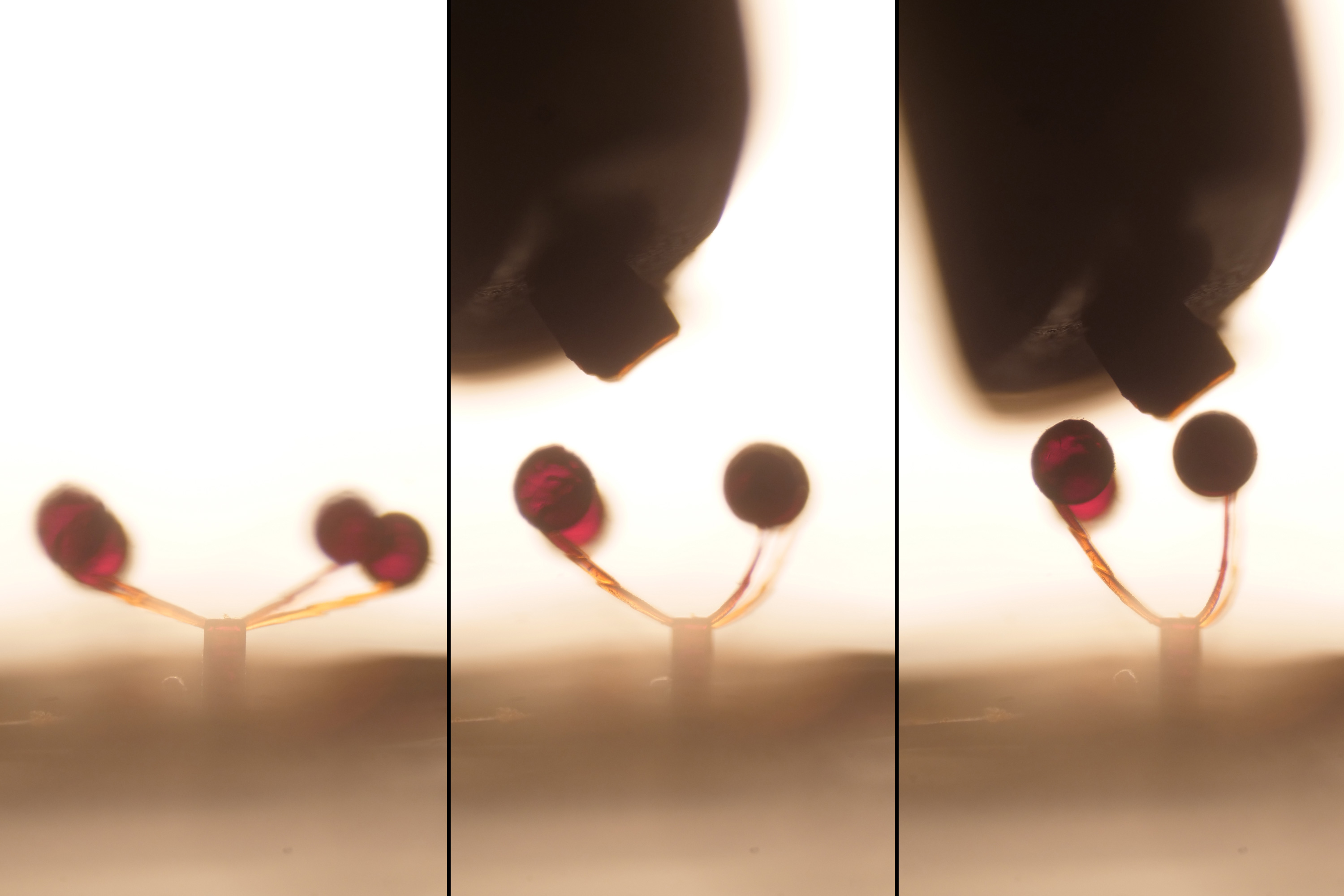
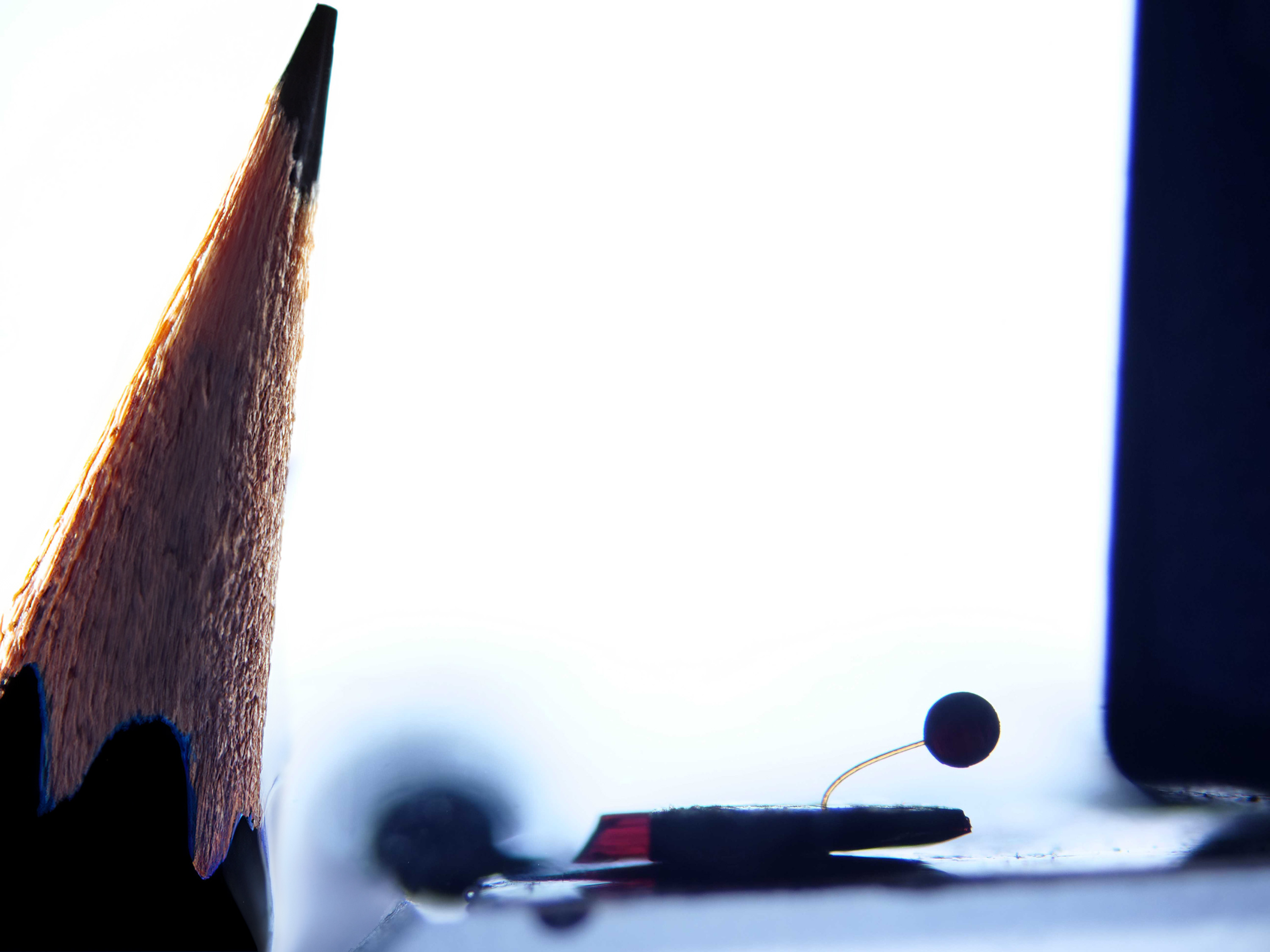
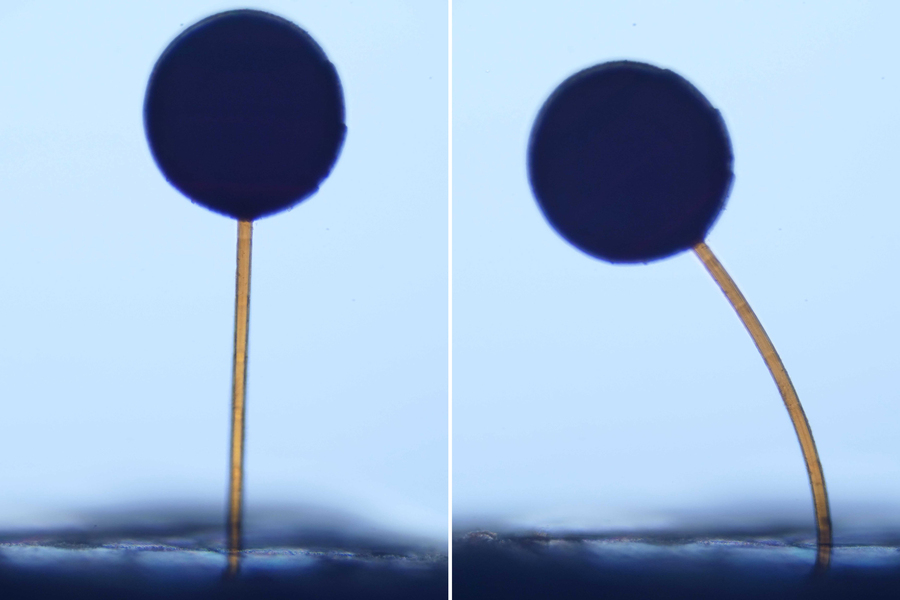
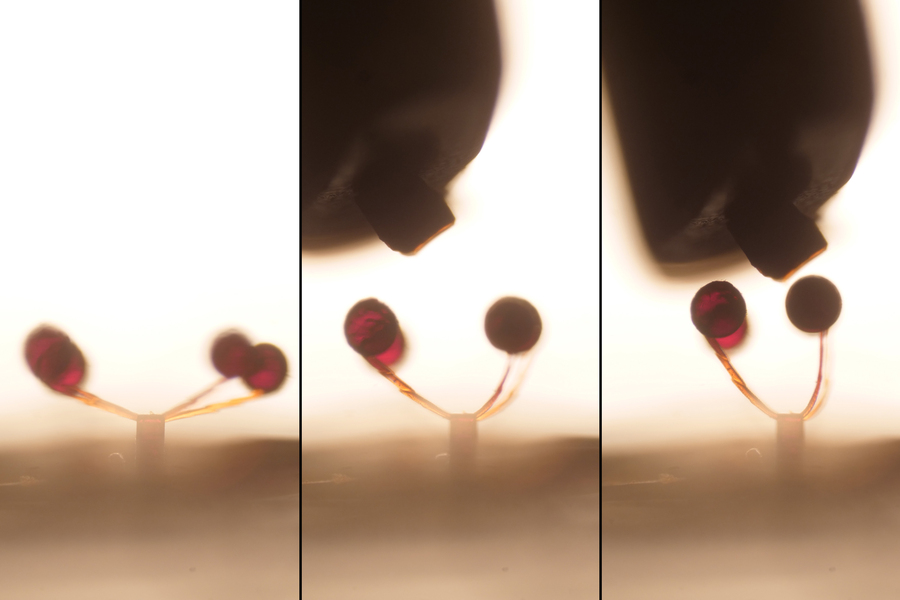
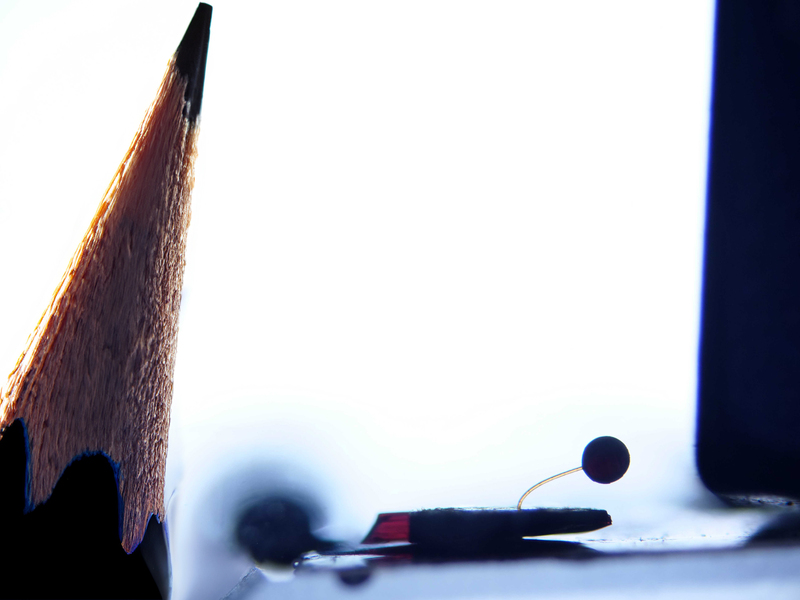
Under a microscope, a bouquet of lollipop-like structures, each smaller than a grain of sand, waves gently in a petri dish of liquid. Suddenly, they snap together, like the jaws of a Venus flytrap, as a scientist waves a small magnet over the dish. What was previously an assemblage of tiny passive structures has transformed instantly into an active robotic gripper.
The lollipop gripper is one demonstration of a new type of soft magnetic hydrogel developed by engineers at MIT and their collaborators at the École Polytechnique Fédérale de Lausanne (EPFL) in Switzerland and the University of Cincinnati. In a study appearing today in the journal Matter, the MIT team reports on a new method to print and fabricate the gel, which can be made into complex, magnetically activated three-dimensional structures.
The new gel could be the basis for soft, microscopic, magnetically responsive robots and materials. Such magno-bots could be used in medicine, for instance to release drugs or grab biopsies when directed by an external magnet.
Making objects move with magnets is nothing new, at least at the macroscale. We can, for example, wave a refrigerator magnet over a pile of paper clips that will trail the magnet in response. And at the microscale, scientists have designed a variety of magnetic “micro-swimmers” — components that are smaller than a millimeter and can be directed remotely by a magnet to squeeze through small spaces. For the most part, these designs work by mixing magnetic particles into a printable resin and pulling the entire swimmer in the direction of an external magnet.

In contrast, the MIT team’s new material can be made into even more complex and deformable structures with micron-scale precision. These features could enable a magnetic millibot to move individual features and perform more complex maneuvers.
“We can now make a soft, intricate 3D architecture with components that can move and deform in complex ways within the same microscopic structure,” says study author Carlos Portela, the Robert N. Noyce Career Development Associate Professor of Mechanical Engineering at MIT. “For soft microscopic robotics, or stimuli-responsive matter, that could be a game-changing capability.”
The study’s MIT co-authors include graduate students Rachel Sun and Andrew Chen, along with Yiming Ji and Daryl Yee of EPFL and Eric Stewart of the University of Cincinnati.
In a flash
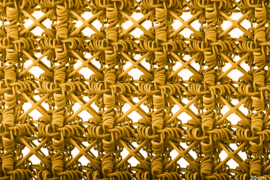
At MIT, Portela’s group develops new metamaterials — materials engineered with unique, microscopic architectures that give rise to beyond-normal material properties. Portela has fabricated a variety of such metamaterials, including extremely tough and stretchy architectures and designs that can manipulate sound and withstand violent impacts.
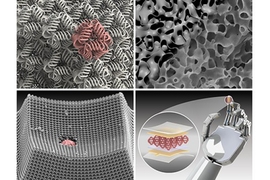
Most recently, he’s expanded his research to “programmable” materials, which can be engineered to change their properties in response to stimuli, such as certain chemicals, light, and electric and magnetic fields.
From the team’s perspective, magnetic stimuli stand out from the rest.
“With a magnetically responsive material, we have control at a distance and the response is instantaneous,” says co-lead author Andrew Chen. “We don’t have to wait for a slow chemical reaction or physical process, and we can manipulate the material without touching it.”
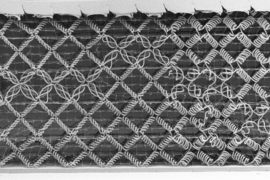
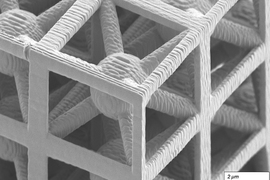
For the new study, the team aimed to create a magnetically responsive metamaterial that can be made into structures smaller than a millimeter. Researchers typically fabricate microstructures by using two-photon lithography — a high-resolution 3D printing technique that flashes a laser into a small pool of resin. With repeated flashes, the laser traces a microscopic pattern into the resin, which solidifies into the same pattern, ultimately creating a tiny, three-dimensional structure, layer by layer.
While 3D resin printing produces intricate microstructures, using the same process to print magnetic structures has been a challenge. Researchers have tried to combine the resin with magnetic nanoparticles before printing the mixture. But magnetic particles are essentially bits of metal that inherently scatter light away or agglomerate and sediment unintentionally. Scientists have found that any magnetic particles in the resin can reduce the laser’s power at a given spot and weaken the resulting structure or prevent its printing altogether.
“Directly 3D printing deformable micron-scale structures with a high fraction of magnetic particles is extremely difficult, often involving a tradeoff between magnetic functionality and structural integrity,” says Sun, a co-lead author on the work.
A printed double-dip
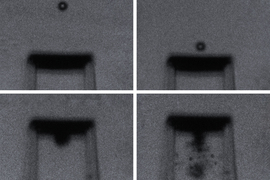
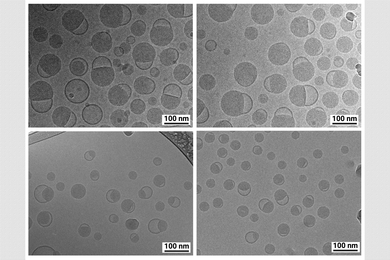
The researchers created a new way to fabricate magnetic microstructures, by combining 3D resin printing with a double-dip process. The researchers first applied conventional resin printing to create a microstructure using a typical polymer gel, with no added magnetic particles. Then they dipped the printed gel into a solution containing iron ions, which the gel can absorb. The iron-soaked structure is then dipped again in a second solution of hydroxide ions. The iron ions in the gel bond with the hydroxide ions, creating iron-oxide nanoparticles that are inherently magnetic.
With this new process, the team can print intricate structures smaller than a millimeter, and add magnetic properties to the structures after printing. What’s more, they are able to control how magnetic a structure’s individual features can be. They found that, by tuning the laser’s power as they print certain features, they can set how cross-linked, or “tight” the gel is when printed. The tighter the gel, the fewer magnetic particles it can form. In this way, the researchers can determine how magnetic each tiny feature can be.
“This provides unprecedented design freedom to print multifunctional structures and materials at the microscale,” Sun says.
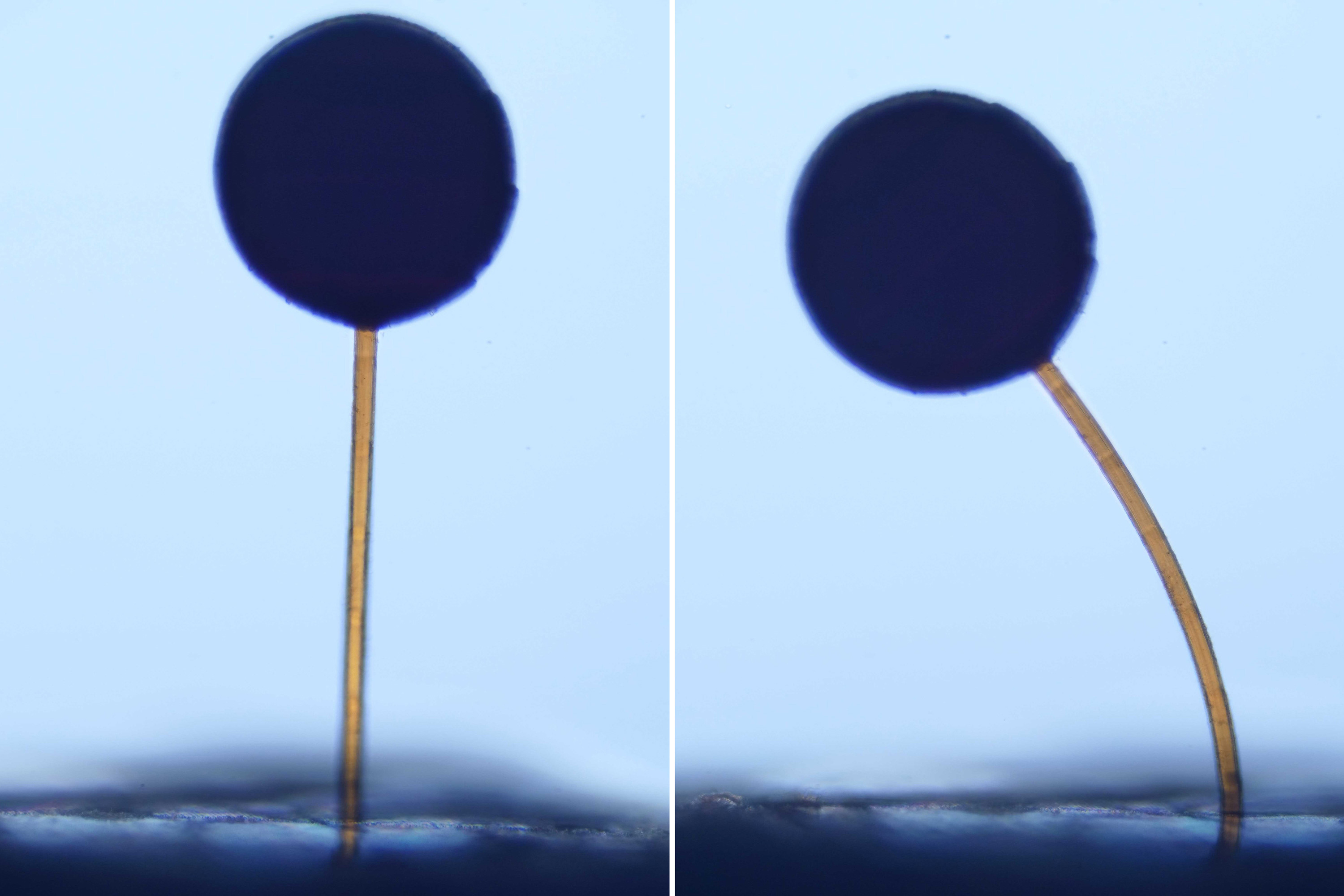
As a demonstration, the team fabricated ball-and-stick structures resembling tiny lollipops. The structures were less than a millimeter in height, with balls that were smaller than a grain of sand. The researchers printed the lollipops out of polymer gel and infused each ball with different amounts of magnetic particles, giving them various degrees of magnetism. Under a microscope, they observed that when they passed an ordinary refrigerator magnet over the structures, the lollipops pulled toward the magnet in various degrees, in a configuration that mimicked gripping fingers.
“You could imagine a magnetic architecture like this could act as a small robot that you could guide through the body with an external magnet, and it could latch onto something, for instance to take a biopsy,” Portela says. “That is a vision that others can take from this work.”
The team also fabricated a magnetically responsive, “bistable” switch. They first printed a small millimeter-long rectangle of polymer gel and attached to either side four tiny, oar-like magnetic structures. Each oar measured about 8 microns thick — about the size of a red blood cell. When the team applied a magnet on one end of the rectangle, the oars flipped toward the magnet, pulling the rectangle in the same direction and locking it in that position. When the magnet was applied to the other side, the oars flipped again, pulling the rectangle, like a switch, in the opposite direction.
“We think this is a new kind of bistable mechanism that could be used, for instance, in a microfluidic device, as a magnetic valve to open or shut some flow,” Portela says. “For now, we’ve figured out how to fabricate magnetic complex architectures at the microscale and also spatially tune their properties. That opens up a lot of interesting ideas for soft miniature robots going forward.”
This research was supported, in part, by the National Science Foundation and the MathWorks seed grant program.
This work was performed, in part, in the MIT.nano fabrication and characterization facilities.