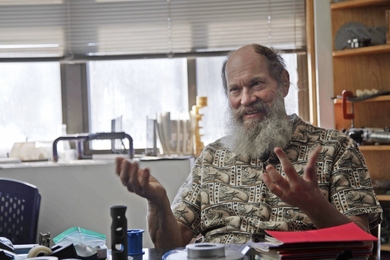
Of all the five senses, the sense of smell is taken the least seriously, Dr. Luca Turin of Flexitral Inc. told a standing-room-only crowd gathered in Room 180 in the Biology Building on Monday, April 4.
"There is a psychological resistance to taking smell seriously," said Turin, who hopes to change that with his lifelong study of scent.
Turin believes the problem is the common misconception that scents are subjective. In fact, he said, "There are a very small number of molecules that smell different to different people."
For scientists, scent has proven elusive because it has been close to impossible to predict a scent by looking at its molecules before synthesis. Traditionally, the shape of molecules has been thought to determine scent, but Turin's theory is that the vibration of molecules is the true cause of smells.
With a Ph.D. in biophysics and physiology from the University of London, Turin has been studying scent for years. Turin's life and research are the subject of a 2003 book by journalist Chandler Burr, "The Emperor of Scent: A Story of Perfume, Obsession and the Last Mystery of the Senses."
In the early 1990s, Turin learned of a device known as the spectroscope that could analyze molecules and their vibrations. He quickly became convinced that the human nose acts as a spectroscope of sorts for scent.
Thus far, his theories have proven to be controversial at best, he said. Turin has identified many molecules that are shaped similarly, but whose scents are different, disproving the more popular shape theory of scent. However, proving his vibration theory has been slightly more difficult, he said. Nevertheless, his research has been successful enough to launch his own scent company, Flexitral. He said Flexitral now has nine synthetic scents on the market.
A version of this article appeared in MIT Tech Talk on April 6, 2005 (download PDF).