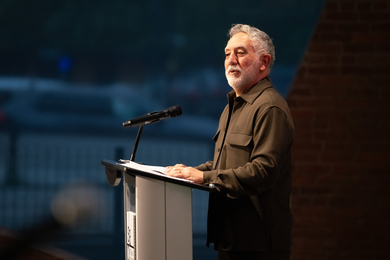
Professor Frank Wilczek, who won the 2004 Nobel Prize in physics, will present the seventh Ford/MIT Nobel Laureate Lecture on Monday, March 7 at 4 p.m. in Kresge Auditorium. The title of his lecture will be "The Universe is a Strange Place." In advance of the upcoming lecture, MIT Cable will broadcast the six previous Nobel lectures this week.
Wilczek's is the final lecture in the five-year series sponsored by Ford Motor Co. He is the 11th Nobel laureate to speak in the wide-ranging series, which sometimes had two or three laureates speaking on similar topics.
Wilczek's presentation will include pictures and a movie. He summarizes the talk this way: "Over the course of the 20th century we have constructed a very successful fundamental theory of the behavior of matter. Viewed from this perspective, the world looks very different from our everyday reality. It is a very strange place and a beautiful one. I'll discuss this, and show in particular how we come to understand the building blocks of matter as notes in a Music of the Void. Finally I'll mention some recent discoveries indicating that the world is even stranger than we've understood so far."
A version of this article appeared in MIT Tech Talk on March 2, 2005 (download PDF).