This year's course assignment for 2.009 (Product Engineering Processes) challenged students to develop products for Habitat for Humanity volunteers and do-it-yourself homeowners in a service learning project.
Product Engineering Processes is the culminating course of the mechanical engineering design curriculum that begins with robot design in 2.007.
Besides engineering, prototype development and business aspects of engineering, students "must work effectively to realize this task, so they learn about group dynamics, team roles and management, consensus building, and the value of communication," said course instructor Woodie Flowers, the Pappalardo Professor of Mechanical Engineering.
The four 14- to 19-member student teams demonstrated their products and business plans on Wednesday evening, Dec. 3, before an audience of about 30 Boston-area professionals who critiqued the students' work.
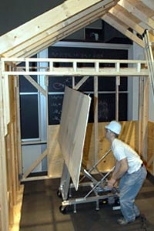
In addition to a drywall lift and installation system, other student projects were an electrically powered scaffold, an electric hoist for roofing jobs and a modular cutting-tool guide system.
Dick Fenner, lecturer and managing director of the Pappalardo Lab, built a shed that students used to demonstrate their inventions. The course is sponsored by the Lemelson Foundation, Ford, General Motors and United Technologies.