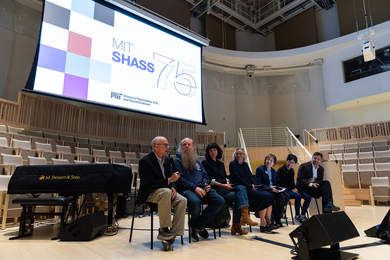
Inventors whose dreams transformed computing, medicine and consumer products named Aristotle, Bob Dylan, Thomas Edison, Galileo, Marvin Minsky, Isaac Newton and Judah Folkman as their personal heroes during a Nov. 27 panel discussion at MIT.
Their freewheeling session formed part of a celebration co-sponsored by the Lemelson-MIT Program and the MIT Press Bookstore on the publication of "Inventing Modern America: From the Microwave to the Mouse" (MIT Press).
"Inventing Modern America" by David E. Brown profiles 35 inventors, detailing the events, people and opportunities that shaped their growth. Lester C. Thurow, the Jerome and Dorothy Lemelson Professor of Management and Economics, wrote the foreword. Historic photographs accompany the 200-page text.
"The book celebrates human imagination. Thanks to that, it's impossible to imagine a world where soldiers go out without Kevlar vests or walkie-talkies, or where people have neither MRI nor cardiac pacemaker technologies," said Rob Lemelson, trustee of the Lemelson Foundation.
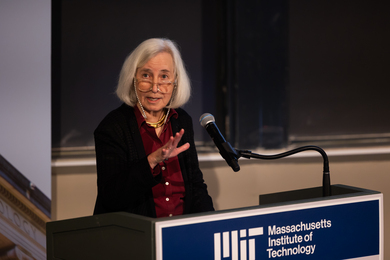
Lemelson and Merton C. Flemings, director of the Lemelson Program and Toyota Professor Emeritus of Materials Science and Engineering, opened the discussion, which was moderated by radio personality Christopher Lydon.
Panel members were Douglas Englebart, inventor of the computer mouse; Brian Hubert, winner of the 2001 Lemelson-MIT Student Prize; Raymond Kurzweil, inventor of an optical reading machine for the blind; Robert Langer, the Germeshausen Professor of Chemical and Biomedical Engineering and inventor of the "pharmacy on a chip" drug delivery system, and Steve Wozniak, co-founder of Apple Computer.
After Lydon challenged the panelists to name their personal "Joe DiMaggios"--people who inspired them to persevere--he asked, "Is there an 'X factor' that separates a first-class professional engineer or biologist from an inventor?"
"Creativity, brilliance and learning how to deal with failure. Most of the time things won't work," Langer said.
"The scientist values knowledge; the inventor takes pleasure in seeing the leap from a dry formula to an impact on people's lives, to making a difference in the real world. Invention in technology is a form of magic: revealing the methods does not ruin its effect. There is magic to any creation," said Kurzweil.
He urged the next generation of inventors to abandon the "myth of the inventor who disappears into his basement and emerges with a breakthrough. Actually, it's a group. Part of inventing is having leadership qualities, a vision, a passion and the ability to get a group to work effectively together."
Englebart recommended that the next generation of inventors nurture collectively their "dreams about how much people can improve. The mouse was just a windshield wiper. There are urgent big problems that have to be dealt with collectively."
A version of this article appeared in MIT Tech Talk on December 5, 2001.