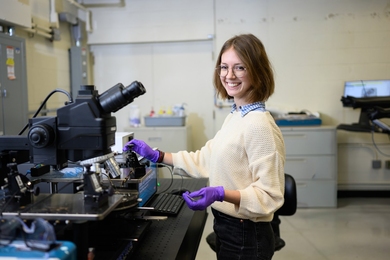
Solving hard problems in soft electronics
Camille Cunin PhD ’26 is transforming rigid circuitry into stretchable, signal-amplifying devices built for real-world biomedical use.
Camille Cunin PhD ’26 is transforming rigid circuitry into stretchable, signal-amplifying devices built for real-world biomedical use.
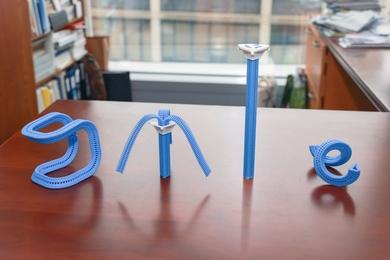
An old patent from MIT Professor Bill Freeman inspired the new “Y-zipper,” a three-sided fastener that snaps gear, robots, and art into shape at the push of a button.
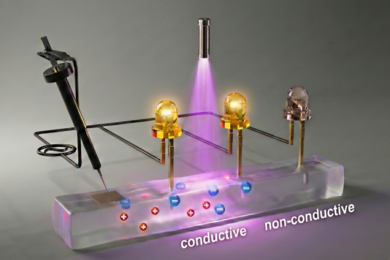
New MIT work advances the growing field of ionotronics, in which data are transferred through ions, potentially providing a bridge between electronics and biological tissue.
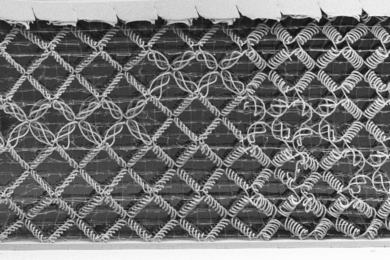
New framework supports design and fabrication of compliant materials such as printable textiles and functional foams, letting users predict deformation and material failure.
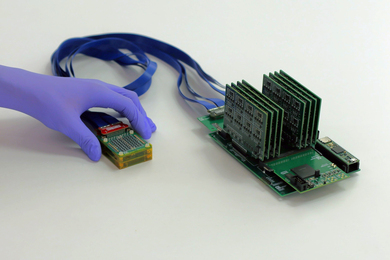
The new system could be used at home or in doctors’ offices to scan people who are at high risk for breast cancer.

Connected by the MIT Human Insight Collaborative, Lecturer Mi-Eun Kim and Research Scientist Praneeth Namburi want to develop an understanding of musical expression and skill development.

Professor of media technology honored for research in human-computer interaction that is considered both fundamental and influential.

Research could help improve motor rehabilitation programs and assistive robot control.

A new design tool uses UV and RGB lights to change the color and textures of everyday objects. The system could enable surfaces to display dynamic patterns, such as health data and fashion designs.
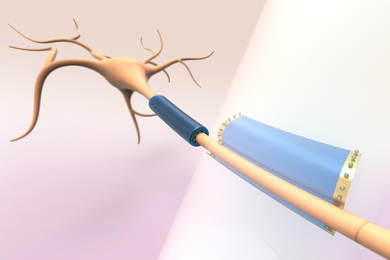
By snugly wrapping around neurons, these devices could help scientists probe subcellular regions of the brain, and might even help restore some brain function.
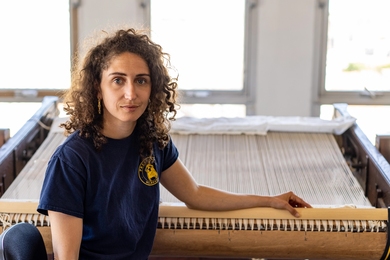
For the MIT Visiting Artist Chloé Bensahel, fabric itself tells the story.

The grants fund studies of clean hydrogen production, fetal health-sensing fabric, basalt architecture, and shark-based ocean monitoring.
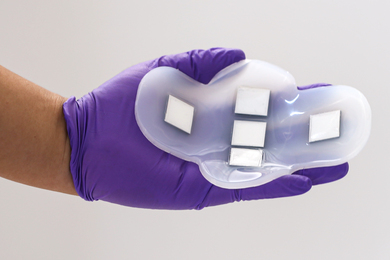
The wearable device, designed to monitor bladder and kidney health, could be adapted for earlier diagnosis of cancers deep within the body.
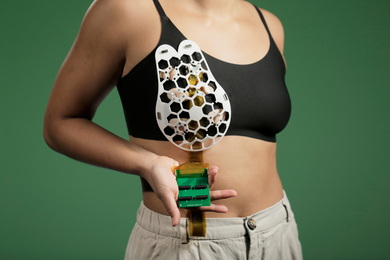
The new device, which can be incorporated into a bra, could allow more frequent monitoring of patients at high risk for breast cancer.
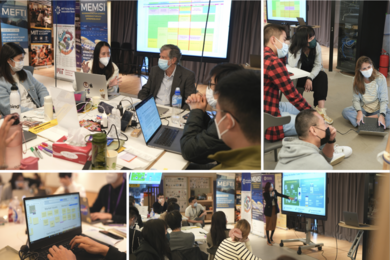
Students develop entrepreneurial mindsets and cultural competency in a startup boot camp.