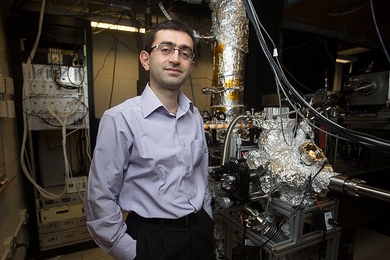
Persuading light to mix it up with matter
MIT team documents a never-before-seen coupling of photons with electrons on the surface of an exotic crystal.
MIT team documents a never-before-seen coupling of photons with electrons on the surface of an exotic crystal.
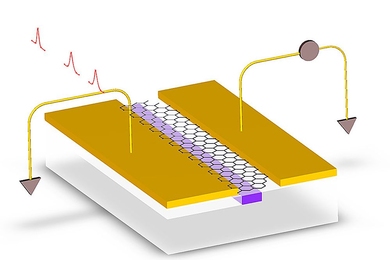
Researchers show that graphene — atom-thick sheets of carbon — could be used in photodetectors, devices that translate optical signals to electrical.
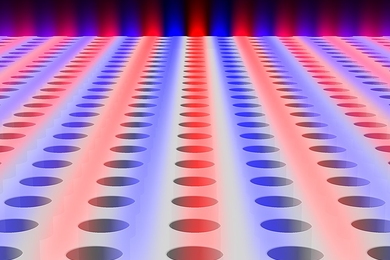
MIT researchers discover a new phenomenon that could lead to new types of lasers and sensors.
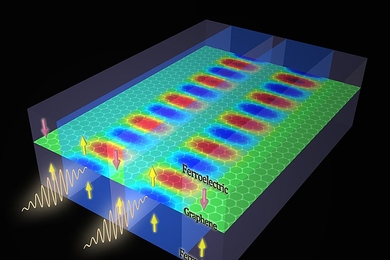
New system uses two-dimensional structures to guide plasmonic waves at ultrashort wavelength, offering a new platform for memory and computer chips.
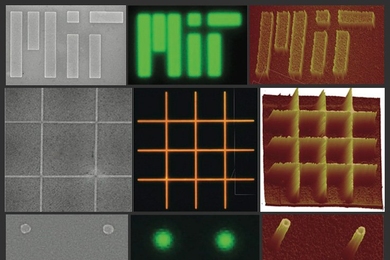
New process developed at MIT could enable better LED displays, solar cells and biosensors — and foster basic physics research.
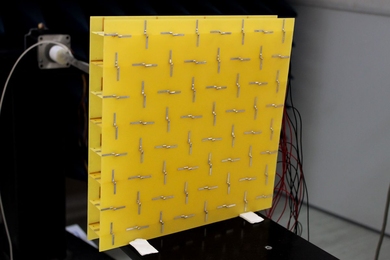
A new ‘metamaterial’ prevents electromagnetic waves from reflecting backward, pointing the way toward computer chips that move data with light.

Tiny cylinders help reveal how natural-light-harvesting antennae collect light with exceptional efficiency.

Materials science and engineering professor studies nanophotonics and electronics.
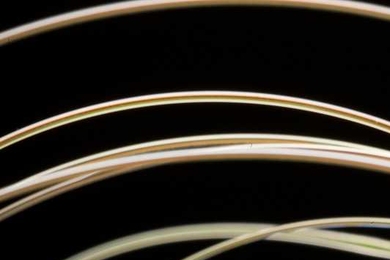
A fiber that can emit light along its length in any direction may herald flexible 3-D displays and medical tools that activate therapeutic compounds with bursts of light.

To keep energy consumption under control, future chips may need to move data using light instead of electricity — and the technical expertise to build them may reside in the United States.
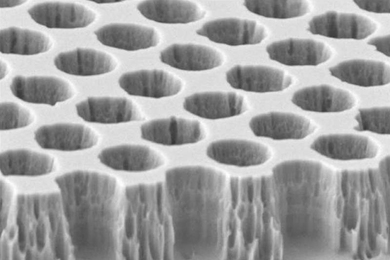
A new kind of high-temperature photonic crystal could someday power everything from smartphones to spacecraft.
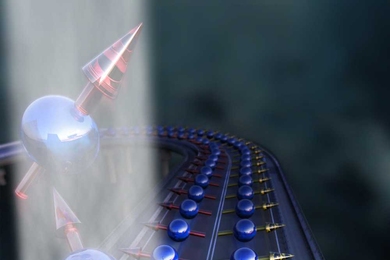
Researchers at MIT find a way to observe and control the way electrons spin on the surface of exotic new materials.
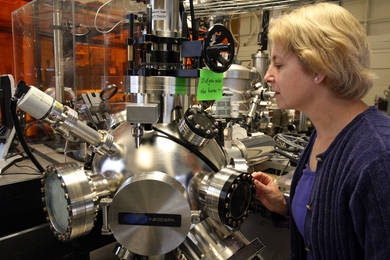
Research at MIT produces long-sought component to allow complete optical circuits on silicon chips.

Succeeds Shapiro to lead one of the Institute’s oldest interdepartmental labs
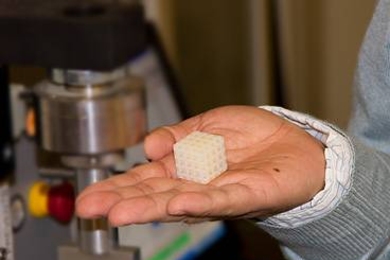
New method of forming composites allows fine-tuning of mechanical, electrical, thermal and other properties.