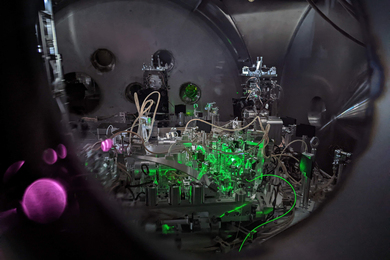

With Psyche, a journey to an ancient asteroid is set to begin
The NASA mission, a project with deep roots at MIT, is setting course for a metallic space rock that could be the remnant of a planetary core like our own.

3 Questions: The first asteroid sample returned to Earth
Richard Binzel describes how asteroid dirt and dust delivered by OSIRIS-Rex, with help from MIT, may reveal clues to the solar system’s origins.

Mikhail Ivanov wins 2024 New Horizons in Physics Breakthrough Prize
MIT assistant professor of physics shares award for understanding the large-scale structure of the universe.
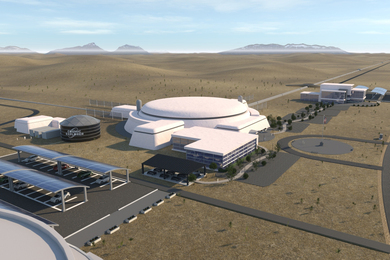
3 Questions: A bigger, better space-ripple detector
The MIT-led Cosmic Explorer project aims to detect gravitational waves from the earliest universe.
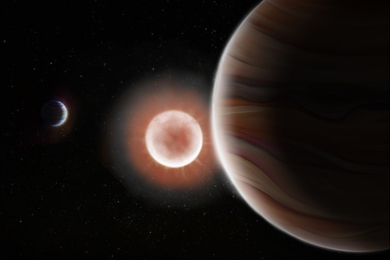
Newly discovered planet has longest orbit yet detected by the TESS mission
The frosty gas giant was discovered in a system that also hosts a warm Jupiter.
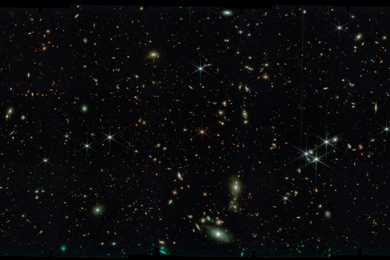
3Q: Exploring the universe’s “first light”
After the James Webb Space Telescope’s first year in service, astronomers are awash in new observations that illuminate the oldest stars and galaxies.

Three Spanish MIT physics postdocs receive Botton Foundation fellowships
Recipients Luis Antonio Benítez, Carolina Cuesta-Lazaro, and Fernando Romero López receive support for their scientific research.
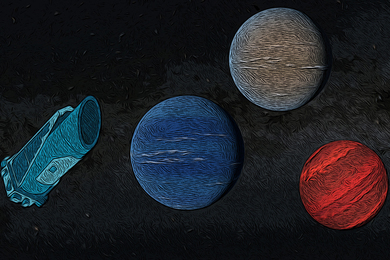
A telescope’s last view
Astronomers discover the last three planets the Kepler telescope observed before going dark.
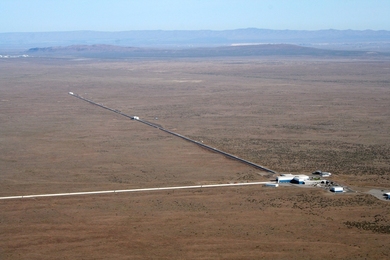
Gravitational-wave detectors start next observing run to explore the secrets of the universe
The next run will be the most sensitive search yet for gravitational waves.

Study doubles the number of known repeating fast radio bursts
Statistics tools support the idea that all radio bursts may repeat if observed long enough.

Research pulled Michael McDonald in and it won’t let go
Since his first encounter with a research telescope, the astrophysics professor hasn't slowed in his quest to understand the behavior of galaxies.
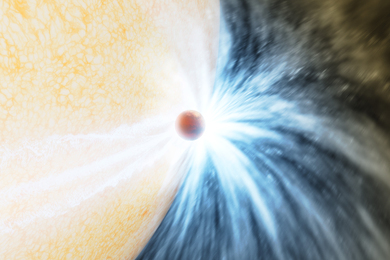
In a first, astronomers spot a star swallowing a planet
Earth will meet a similar fate in 5 billion years.
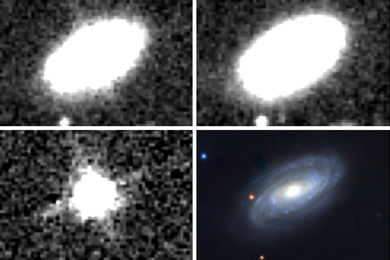
Astronomers detect the closest example yet of a black hole devouring a star
The event was spotted in infrared data — also a first — suggesting further searches in this band could turn up more such bursts.
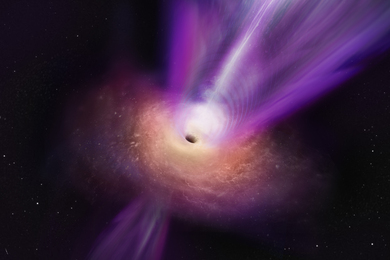
New black hole images reveal a glowing, fluffy ring and a high-speed jet
The observations will help astronomers pin down the physics of the plasma around black holes.