
Enhancing maritime cybersecurity with technology and policy
Strahinja Janjusevic brings an international perspective and US Naval Academy education to his graduate research in the MIT Technology and Policy Program.
Strahinja Janjusevic brings an international perspective and US Naval Academy education to his graduate research in the MIT Technology and Policy Program.
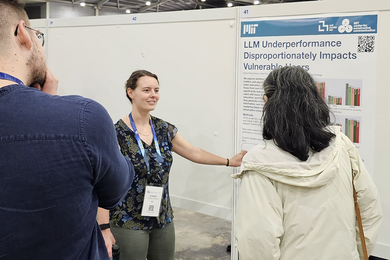
Research from the MIT Center for Constructive Communication finds leading AI models perform worse for users with lower English proficiency, less formal education, and non-US origins.
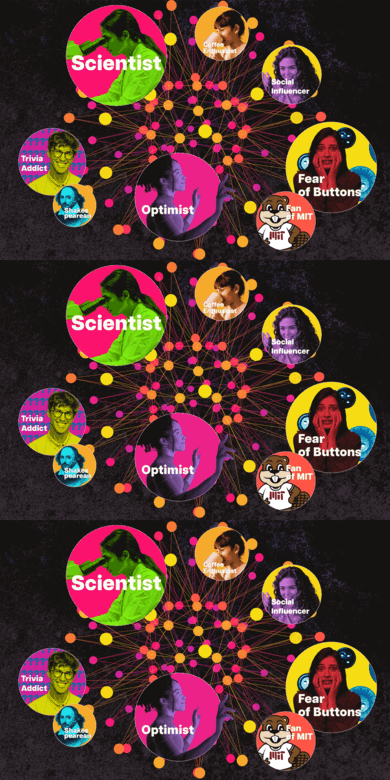
A new method developed at MIT could root out vulnerabilities and improve LLM safety and performance.

By minimizing the need to drive around looking for a parking spot, this technique can save drivers up to 35 minutes — and give them a realistic estimate of total travel time.

The context of long-term conversations can cause an LLM to begin mirroring the user’s viewpoints, possibly reducing accuracy or creating a virtual echo-chamber.

Project AI Evidence will connect governments, tech companies, and nonprofits with world-class economists at MIT and across J-PAL's global network to evaluate and improve AI solutions.

Associate Professor Rafael Gómez-Bombarelli has spent his career applying AI to improve scientific discovery. Now he believes we are at an inflection point.

Driven by overuse and misuse of antibiotics, drug-resistant infections are on the rise, while development of new antibacterial tools has slowed.
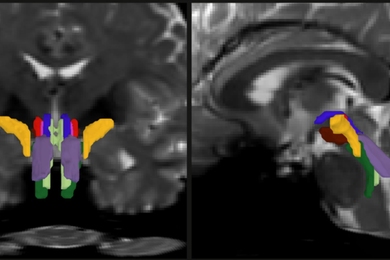
Opening a new window on the brainstem, a new tool reliably and finely resolves distinct nerve bundles in live diffusion MRI scans, revealing signs of injury or disease.

MIT Sports Lab researchers are applying AI technologies to help figure skaters improve. They also have thoughts on whether five-rotation jumps are humanly possible.

Removing just a tiny fraction of the crowdsourced data that informs online ranking platforms can significantly change the results.

MIT faculty join The Curiosity Desk to discuss football, math, Olympic figure skating, AI and the quest to cure ovarian cancer.
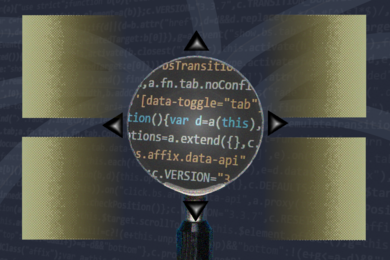
EnCompass executes AI agent programs by backtracking and making multiple attempts, finding the best set of outputs generated by an LLM. It could help coders work with AI agents more efficiently.

He joins Nikos Trichakis in guiding the cross-cutting initiative of the MIT Schwarzman College of Computing.

Torralba’s research focuses on computer vision, machine learning, and human visual perception.