MIT researchers advance toward greater bandwidth, more energy-efficient communications
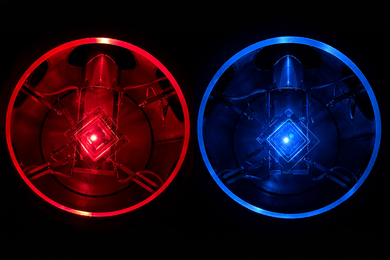
The FUTUR-IC research program integrates electronics and photonics in microchip systems.
Associate Professor Anna Huang delivers the keynote address, “In Search of Human-AI Resonance,” to a capacity crowd.
A hands-on boot camp teaches integrated photonics to community and four-year college students in the region.
A new system, known as Murakkab, optimizes the design and deployment of multistep workflows that power AI applications.
The cost-effective devices, which can be built in hours, leverage electrospray emitter technology to efficiently produce three-layered particles at scale.
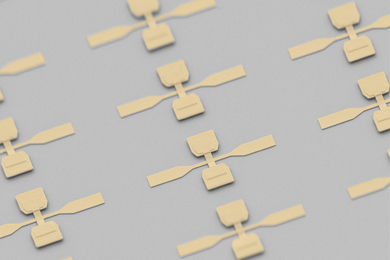
By using a thin layer of diamond to manage excessive heat, researchers can boost the speed and energy-efficiency of next-generation wireless devices.
A new technique helps scientists measure a phenomenon that can cause quantum circuits to perform differently than expected, increasing the error in computations.
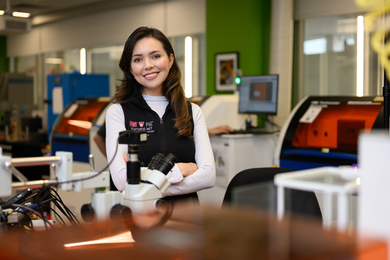
Camille Cunin PhD ’26 is transforming rigid circuitry into stretchable, signal-amplifying devices built for real-world biomedical use.
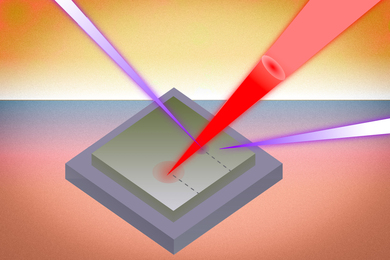
With a novel design, MIT researchers overcame a stubborn problem that has limited the effectiveness of chip-based systems for lidar.
MIT researchers leveraged a surprise discovery to devise a faster and more precise biomedical imaging technique.
Startup accelerator program grows to over 30 companies, almost half of them with MIT pedigrees.
Researchers developed a system that intelligently balances workloads to improve the efficiency of flash storage hardware in a data center.
MIT physicists have discovered 3D “moiré crystals” that simulate four-dimensional quantum materials to a T.
The electrical engineering and nanotechnology leader will guide the US Army-sponsored research center as it advances next-generation materials, electronics, and photonics for national security.