
Estimating suicide risk from text
A new language-processing tool could help identify the highest-risk individuals from natural language, enabling swifter interventions.
A new language-processing tool could help identify the highest-risk individuals from natural language, enabling swifter interventions.

Patricia and James Poitras ’63 provide fellowships for graduate students and postdocs who will shape the future of mental health research.

A commitment from longtime supporters Patricia and James Poitras ’63 initiates multidisciplinary efforts to understand and treat complex psychiatric disorders.

Co-hosted by the McGovern Institute, MIT Open Learning, and others, the symposium stressed emerging technologies in advancing understanding of mental health and neurological conditions.

New research addresses a gap in understanding how ketamine’s impact on individual neurons leads to pervasive and profound changes in brain network function.
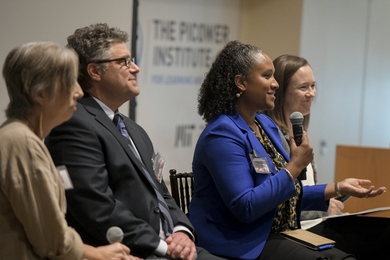
Symposium speakers describe numerous ways to promote prevention, resilience, healing, and wellness after early-life stresses.
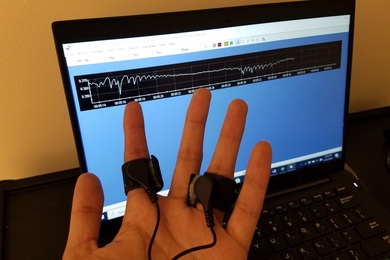
By accounting for sweat physiology, method can make better use of electrodermal activity for tracking subconscious changes in physical or emotional state.

Collaborative research center funded by Lisa Yang and Hock Tan ’75 blends engineering and neuroscience to advance molecular tools for treating brain disorders.

CCI and Takeda collaborate on a theoretical approach leveraging networks of people and machines in support of individuals experiencing depression.

Solstice makes community solar projects more accessible for people unable to invest in rooftop panels.
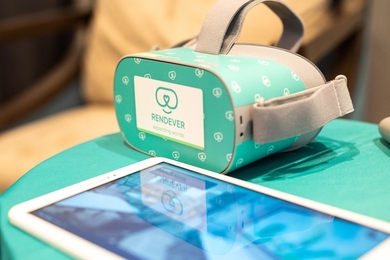
Rendever’s VR platform brings new experiences and fond memories to aging adults in nursing homes.

Gifts to MIT and Harvard Medical School totaling $9 million will fund independent research on cannabinoid’s influence on brain health and behavior.
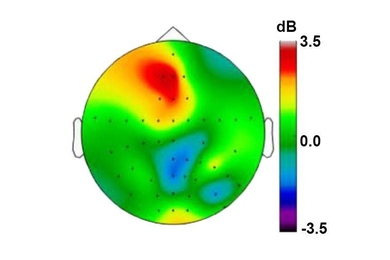
Finding could improve development of personalized psychiatric treatments.
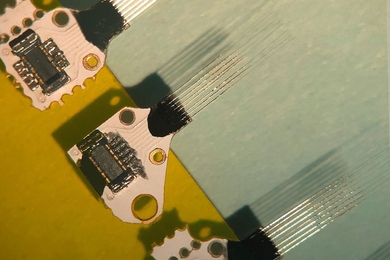
Tiny probes could be useful for monitoring patients with Parkinson’s and other diseases.

Neural network learns speech patterns that predict depression in clinical interviews.