
Responding to the climate impact of generative AI
Explosive growth of AI data centers is expected to increase greenhouse gas emissions. Researchers are now seeking solutions to reduce these environmental harms.
Explosive growth of AI data centers is expected to increase greenhouse gas emissions. Researchers are now seeking solutions to reduce these environmental harms.

A lantern created in the Design Intelligence Lab creates sustainable alternatives for consumer electronics.

How does one access and conduct research in one of the world’s harshest and most demanding environments? Lincoln Laboratory undersea systems engineer David Whelihan explains.

J-PAL North America’s inaugural Climate Action Learning Lab provided six U.S. cities and states with customized training and resources to leverage data and evaluation to advance climate solutions that work.

New research shows the natural variability in climate data can cause AI models to struggle at predicting local temperature and rainfall.

An analysis of social media in 157 countries finds hotter weather is associated with more negative sentiments.

Trancik will lead multidisciplinary research center focused on the high-impact, complex, sociotechnical systems that shape our world.

New research can identify opportunities to drive down the cost of renewable energy systems, batteries, and many other technologies.

New research shows automatically controlling vehicle speeds to mitigate traffic at intersections can cut carbon emissions between 11 and 22 percent.

An MIT study shows decreases in seed-dispersing animals can lead to a major reduction in forest carbon absorption.

The findings could enable new ways to increase plants’ resilience to UV stress and enhance seedling growth.

A project at the Venice Biennale showcases biodegradable materials and structural systems using tension and compression.

MIT’s first vice president for energy and climate is working to accelerate research and development toward transformational solutions.

How experience with real-world problem-solving, combined with MIT Open Learning’s online resources and internship opportunities, solidified one Afghani learner’s career path.
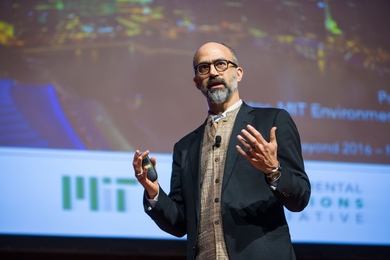
John Fernandez will step down as head of the Environmental Solutions Initiative, as its components will become part of the Climate Project and other entities.