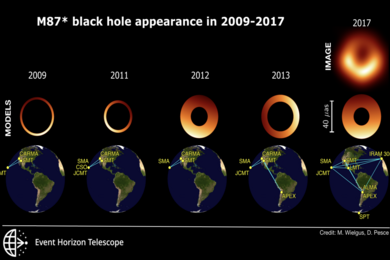
The wobbling shadow of the M87* black hole
Analysis of Event Horizon Telescope observations from 2009 to 2017 reveals turbulent evolution of the M87* black hole image.
Analysis of Event Horizon Telescope observations from 2009 to 2017 reveals turbulent evolution of the M87* black hole image.
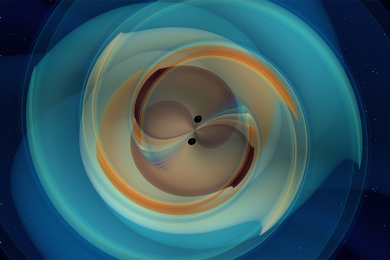
A binary black hole merger likely produced gravitational waves equal to the energy of eight suns.
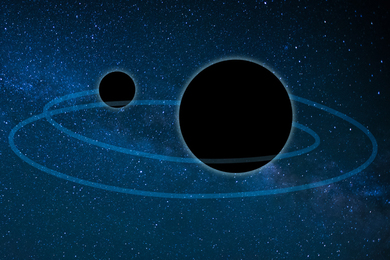
Researchers suggest a novel process to explain the collision of a large black hole and a much smaller one.
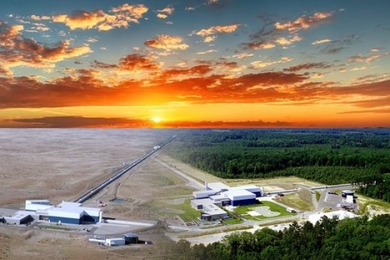
Despite the planet’s seeming standstill, graduate students continue to use LIGO to identify astrophysical events.
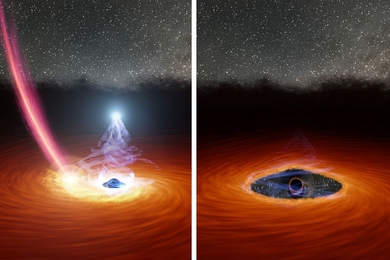
A colliding star may have triggered the drastic transformation.
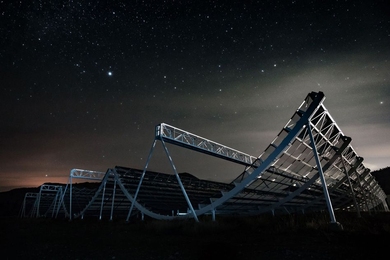
Signal from 500 million light years away is the first periodic pattern of radio bursts detected.
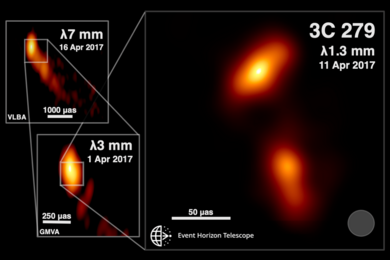
MIT Haystack Observatory researchers coauthor a paper announcing the observation of a surprising structure in a distant quasar, 3C 279.

Awards program annually recognizes three early-career scientists under 35 who have made outstanding contributions to astronomy.
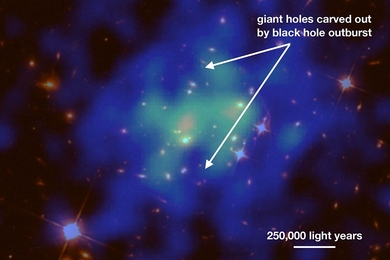
Michael Calzadilla and colleagues describe a violent black hole outburst that provides new insight into galaxy cluster evolution.
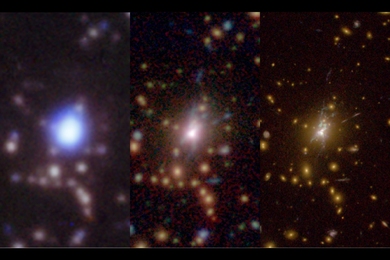
With increasingly advanced data, Michael McDonald and colleagues study a galaxy cluster bursting with new stars.
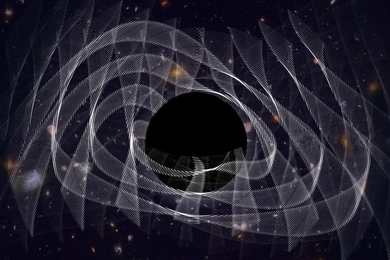
Results support Einstein’s theory and the idea that black holes have no “hair.”
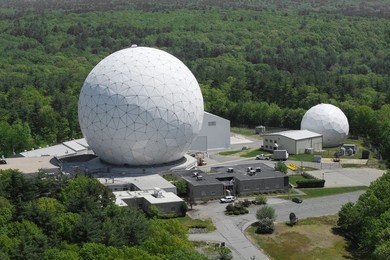
Nearly 30 MIT-affiliated researchers will share in the prize, while David Jay Julius ’77 wins Breakthrough Prize in Life Sciences; assistant professor of physics Max Metlitski shares New Horizons prize with Xie Chen PhD ’12 and Michael Levin PhD ’06.
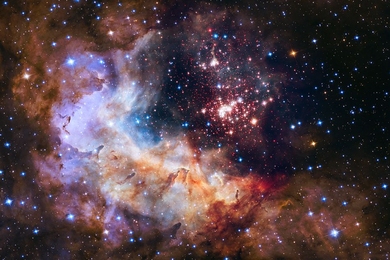
With help from next-generation particle accelerators, the approach may nail down the rate of oxygen production in the universe.
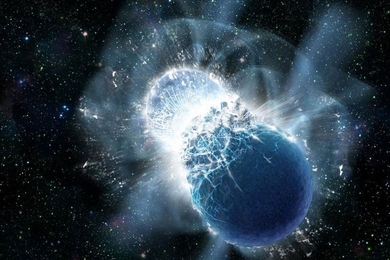
Findings reported just weeks into the network’s latest operating run. (Press release)
“We will keep listening for these faint and remote cosmic whispers,” says the physics professor.