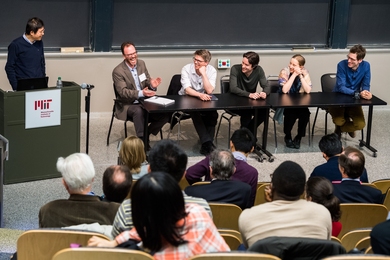
Center for Theoretical Physics celebrates 50 years
Symposium explores how novel ideas and experiments are advancing many areas of theoretical physics in newly interconnected ways.
Symposium explores how novel ideas and experiments are advancing many areas of theoretical physics in newly interconnected ways.
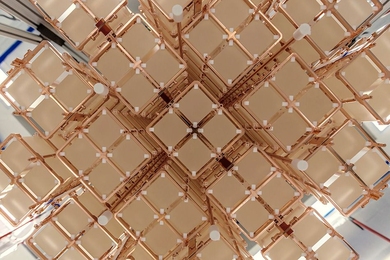
Data could shed light on why the universe has more matter than antimatter.
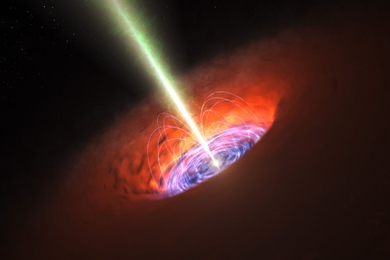
Signals suggest black hole emits a jet of energy proportional to the stellar material it gobbles up.
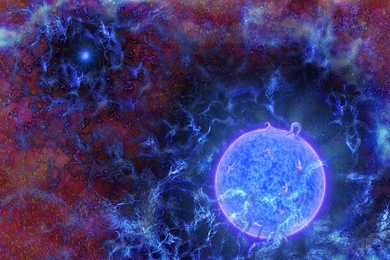
Emitted just 180 million years after Big Bang, signal indicates universe was much colder than expected.

The 51 Pegasi b Postdoctoral Fellowship provides junior scientists the opportunity to conduct theoretical, observational, and experimental research in planetary astronomy.
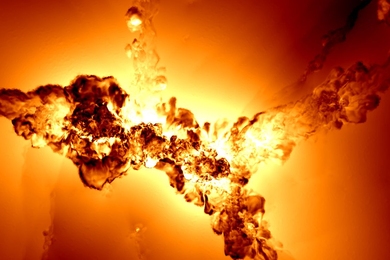
MIT's Mark Vogelsberger and an international astrophysics team have created a new model pointing to black holes’ role in galaxy formation.
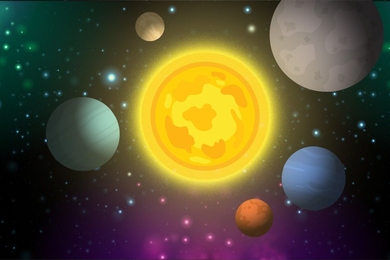
The planetary system’s dense configuration gives clues to its formation
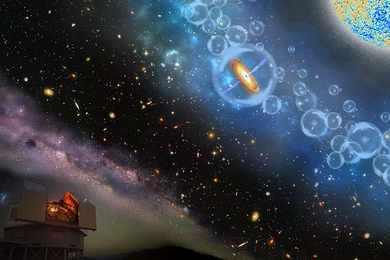
Findings present a puzzle as to how such a huge object could have grown so quickly.
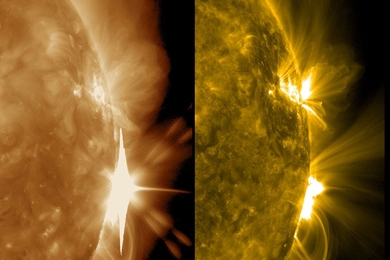
Theoretical analysis uncovers new mechanisms in plasma turbulence.
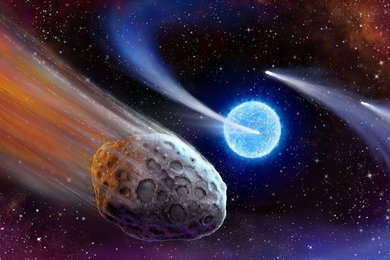
Team of professional and citizen scientists identifies tails of comets streaking past a distant star.
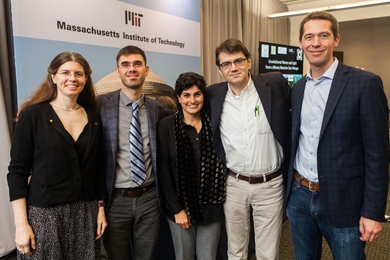
Mavalvala, Evans, Frebel, Katsavounidis, and Vitale discuss the science behind LIGO's observations of a neutron star collision.
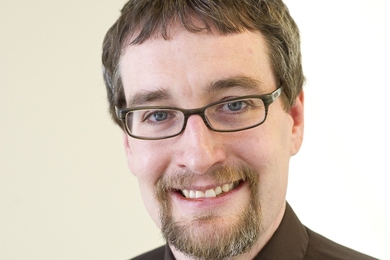
Professor of physics describes our understanding of the expansion of the universe through “standard sirens.”
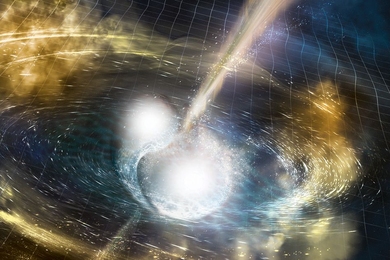
Discovery marks first cosmic event observed in both gravitational waves and light.
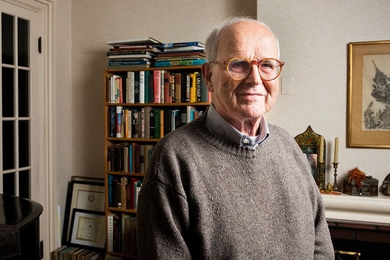
LIGO inventor and professor emeritus of physics recognized “for decisive contributions to the LIGO detector and the observation of gravitational waves.”
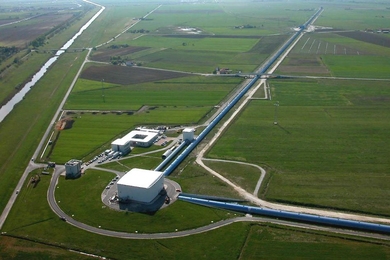
Finding represents first joint detection of gravitational waves with both detectors.