

Rough calculations
Sanjoy Mahajan’s new book, Street-Fighting Mathematics, lays out practical tools for educated guessing and down-and-dirty problem-solving


No harm, no foul
Study of moral judgment finds that patients with a specific brain defect lack the emotional reaction necessary to find fault with attempted murderers

Explained: Dynamo theory
Recent discoveries raise questions about how small planets can have self-sustaining magnetic fields
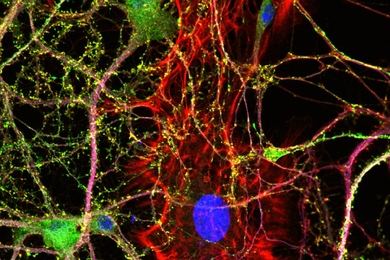
A change of mind
One protein appears to control neurons’ ability to react to new experiences, MIT scientists show.

MIT wins Putnam math competition
Seniors Qingchun Ren and Yufei Zhao finish in top five, helping MIT secure overall victory and end a four-year drought.

Mapping Venus
New analysis supports theory that Venus’ surface evolved through extreme makeover, not plate tectonics

Explained: Climate sensitivity
If we double the Earth’s greenhouse gases, how much will the temperature change? That’s what this number tells you.

Bacteria divide like clockwork
MIT researchers show how circadian rhythms in bacteria control their rate of reproduction.

McGovern Institute for Brain Research launches new web site
Redesign comes as institute nears its 10th anniversary

Weather in a Tank
A curriculum built around a rotating-tank experiment could improve weather and climate education

Explained: Regression analysis
Sure, it’s a ubiquitous tool of scientific research, but what exactly is a regression, and what is its use?

Wind resistance
MIT analysis suggests generating electricity from large-scale wind farms could influence climate — and not necessarily in the desired way.

Explained: Radiative forcing
When there’s more energy radiating down on the planet than there is radiating back out to space, something’s going to have to heat up