
Department
Electrical Engineering and Computer Science

Measuring blood flow to monitor sickle cell disease
New technology may help doctors predict when patients are at risk for serious complications.
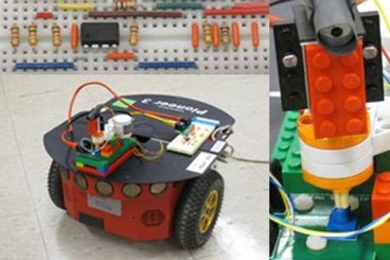
Introduction to Electrical Engineering and Computer Science now available in OCW Scholar format
6.01SC is the fourth of seven courses OCW will publish this spring specifically to meet the needs of independent learners.
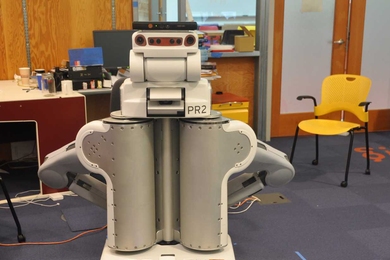
New system allows robots to continuously map their environment
Algorithm to build 3-D maps requires a low-cost camera, no human input.
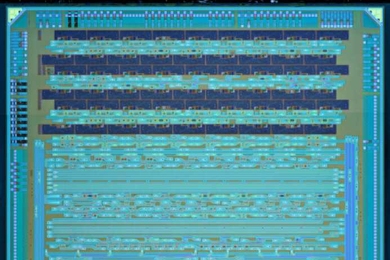
Microchips’ optical future
To keep energy consumption under control, future chips may need to move data using light instead of electricity — and the technical expertise to build them may reside in the United States.

MITx prototype course opens for enrollment
Online-learning initiative’s first offering, ‘6.002x: Circuits and Electronics,’ accepting registrants now.


The blind codemaker
New error-correcting codes guarantee the fastest possible rate of data transmission, even over fluctuating wireless links.

The faster-than-fast Fourier transform
For a large range of practically useful cases, MIT researchers find a way to increase the speed of one of the most important algorithms in the information sciences.

The quantifier
By helping biologists turn their hunches into rigorous mathematical models, Polina Golland builds software that interprets medical images.
Self-aware computing project named a 'world changing' idea by Scientific American
Project Angstrom selected by magazine's editors; featured in December issue
Research update: Sharpening the lines
New advance could lead to even smaller features in the constant quest for more compact, faster microchips.
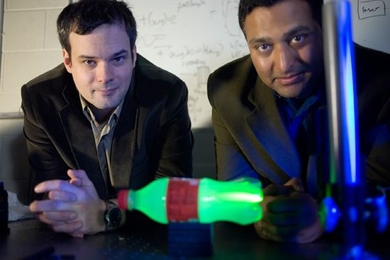
Trillion-frame-per-second video
By using optical equipment in a totally unexpected way, MIT researchers have created an imaging system that makes light look slow.

Putting the ‘art’ in artificial intelligence
CSAIL associate professor develops AI systems that can interpret images.