
A new facet for germanium
MIT researchers grow perfectly shaped germanium tunnels on silicon oxide with controllable length.
MIT researchers grow perfectly shaped germanium tunnels on silicon oxide with controllable length.
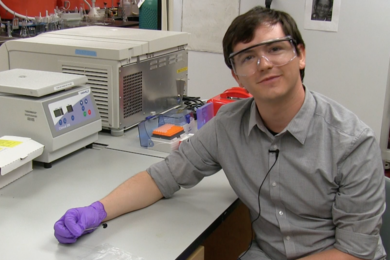
MIT graduate student Seth Cazzell shows controlling pH enables reversible hydrogel formation in wider range of metal concentrations.
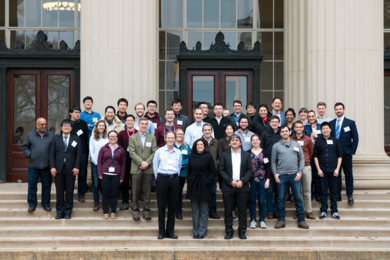
“Micromechanics informed alloy design: Overcoming scale-transition challenges” focuses on bridging scale gaps.

Newly synthesized compound of iron and tin atoms in 1-to-1 ratio displays unique behavior.

Skylar Tibbits makes materials that water, heat, or mechanical forces can alter into new shapes.
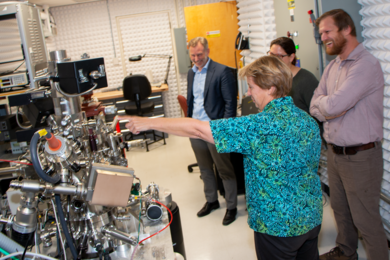
Transmission electron microscope and scanning tunneling microscope offer unique capabilities.

Materials Day speaker Brian Storey describes how the Toyota Research Institute is embracing machine learning to advance the use of electric vehicles.
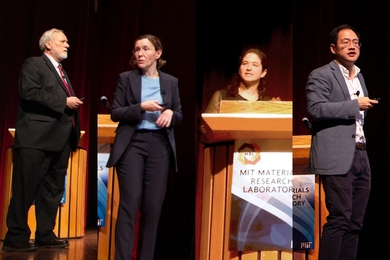
The ability to predict and make new materials faster highlights the need for safety, reliability, and accurate data.

Materials Research Science and Engineering Center welcomed area students for lessons in glassblowing, making motors, and making ice cream.
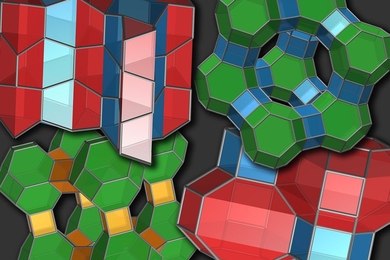
Study of minerals widely used in industrial processes could lead to discovery of new materials for catalysis and filtering.

Associate Professor Juejun Hu shines a light on the impact machine learning and AI are having on materials science and engineering.
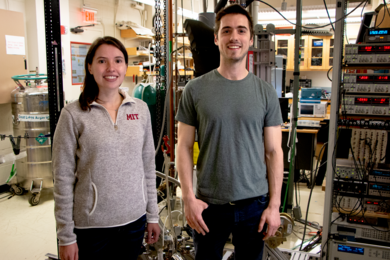
MIT researchers discover why magnetism in certain materials is different in atomically thin layers and their bulk forms.
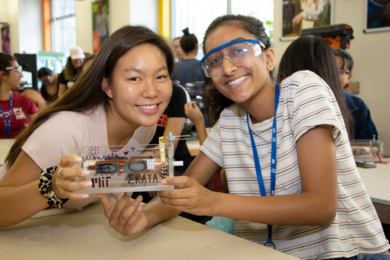
Materials Research Laboratory’s Materials Research Science and Engineering Center sponsors a motor-building workshop.
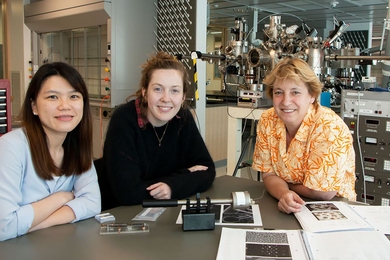
MIT Professor Frances Ross is pioneering new techniques to study materials growth and how structure relates to performance.
MIT researchers have developed a new technique to reveal the uncharted dynamics of electrons in materials.