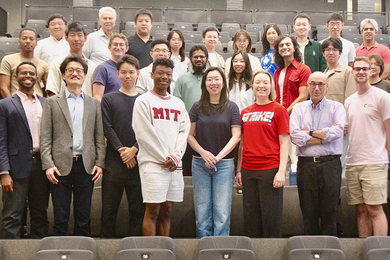
A total of 97 faculty international research projects have received $1.99 million in funding from the 2012-2013 MISTI Global Seed Funds competition. These projects were selected from among 196 proposals submitted by faculty and research scientists from 22 departments across the Institute.
MISTI Global Seed Funds (MISTI GSF) was established to enhance the internationalization of MIT research and education. The program is composed of a general pool of funds for projects in any country and several country-specific funds. In the latest grant cycle, MISTI offered significant new funds for collaboration with Mexico and Russia. Matching funds for projects in Brazil from the Brazilian National Council for Scientific and Technological Development were also awarded.
Since 2008, the program has awarded $6 million to 304 projects. Winning teams use grant funds to cover international travel, meeting and workshop costs. All awardees include undergraduate, graduate or postdoctoral student participation.
MIT's largest international program, MISTI is a pioneer in applied international studies. Each year, the program places over 675 MIT students in professional internships and research positions with its network of leading companies, universities, research institutes and NGOs around the world. MISTI currently operates in 17 countries: Belgium, Brazil, Chile, China, France, Germany, India, Israel, Italy, Japan, Korea, Mexico, the Netherlands, Russia, Singapore, Spain and Switzerland. The program is a part of the Center for International Studies.
The next MISTI Global Seed Funds call for proposals will be announced in May with a proposal deadline in early fall. More details are available on the MISTI website.
MISTI Global Seed Funds (MISTI GSF) was established to enhance the internationalization of MIT research and education. The program is composed of a general pool of funds for projects in any country and several country-specific funds. In the latest grant cycle, MISTI offered significant new funds for collaboration with Mexico and Russia. Matching funds for projects in Brazil from the Brazilian National Council for Scientific and Technological Development were also awarded.
Since 2008, the program has awarded $6 million to 304 projects. Winning teams use grant funds to cover international travel, meeting and workshop costs. All awardees include undergraduate, graduate or postdoctoral student participation.
MIT's largest international program, MISTI is a pioneer in applied international studies. Each year, the program places over 675 MIT students in professional internships and research positions with its network of leading companies, universities, research institutes and NGOs around the world. MISTI currently operates in 17 countries: Belgium, Brazil, Chile, China, France, Germany, India, Israel, Italy, Japan, Korea, Mexico, the Netherlands, Russia, Singapore, Spain and Switzerland. The program is a part of the Center for International Studies.
The next MISTI Global Seed Funds call for proposals will be announced in May with a proposal deadline in early fall. More details are available on the MISTI website.