Skip to content ↓

Brain control

Ed Boyden is learning how to alter behavior by using light to turn neurons on and off.
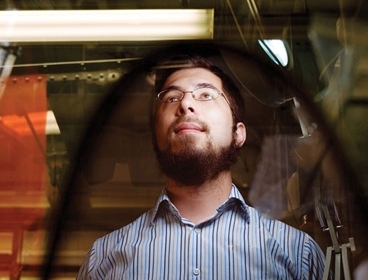
In his MIT lab, Ed Boyden studies how photosensitive proteins can be used to affect the workings of the brain.
Caption:
In his MIT lab, Ed Boyden studies how photosensitive proteins can be used to affect the workings of the brain.
Credits:
Photo: Dana Smith

tktkt

Press Mentions

Forbes

In a piece for Forbes, Josh Wolfe interviews Prof. Edward Boyden about his work with optogenetics and his new research at MIT. “I’m very excited about these new kinds of microscopes that we’re building that allow you to map all the neural activity in a complete organism,” says Boyden of his current work. 

WBUR

Carey Goldberg of WBUR features Prof. Ed Boyden’s optogenetics research in a segment on neuroscience advances. “We might be in a golden age of making such tools because most fields of engineering had not been applied to the brain, so there’s just a gold rush of possibility,” says Boyden.


Related Topics

More MIT News

Globular blue and white orbs "examining" single-stranded RNA products and marking them with green checks or red x's

Why are some bacterial genes high in purines?

In certain species of bacteria, the answer lies in shielding RNA transcripts from a quality-control factor called Rho. Understanding the requirements for expressible sequences is critical for expression engineering of therapeutic agents.

Read full story

Rich Nielsen, Volha Charnysh, Kevin Dorst, and Emily Richmond Pollock seated at a table, talking

Building a scholarly community

The SHASS Faculty Fellows Program, administered by the MIT Human Insight Collaborative, is fostering new research projects and creating space for supportive and interdisciplinary discussion.

Read full story