Subra Suresh, former dean of MIT’s School of Engineering, was officially sworn in on Monday as director of the National Science Foundation.
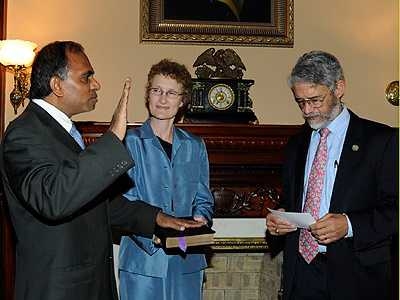
John Holdren ’65, SM ’66, President Barack Obama’s science adviser and director of the Office of Science and Technology Policy, administered the oath of office to Suresh in the Secretary of War Ceremonial Room of the Eisenhower Executive Office Building in Washington.
As NSF director, Suresh will lead a $7.4 billion independent federal agency that supports all fields of science and engineering research, as well as a wide span of educational programs that reach more than 2,000 institutions across the U.S. and involve approximately 200,000 educators, researchers and students. NSF funding accounts for more than half of all non-medical science and engineering basic research at American academic institutions.
Obama nominated Suresh to lead the NSF earlier this year, and the U.S. Senate confirmed the nomination in September. Cynthia Barnhart, Ford Professor of Engineering, has assumed the role of interim dean of the School of Engineering.
John Holdren ’65, SM ’66, President Barack Obama’s science adviser and director of the Office of Science and Technology Policy, administered the oath of office to Suresh in the Secretary of War Ceremonial Room of the Eisenhower Executive Office Building in Washington.
As NSF director, Suresh will lead a $7.4 billion independent federal agency that supports all fields of science and engineering research, as well as a wide span of educational programs that reach more than 2,000 institutions across the U.S. and involve approximately 200,000 educators, researchers and students. NSF funding accounts for more than half of all non-medical science and engineering basic research at American academic institutions.
Obama nominated Suresh to lead the NSF earlier this year, and the U.S. Senate confirmed the nomination in September. Cynthia Barnhart, Ford Professor of Engineering, has assumed the role of interim dean of the School of Engineering.