Streaming matter! Exploding organisms! Sinking particles! These are some of the things that populate the world of oceanic bacteria, providing the microorganisms with nutrition and perhaps exercise as they race for food, according to Professor Roman Stocker of the Department of Civil and Environmental Engineering, who is among those who have challenged the traditional view that ocean bacteria rarely swim, but passively wait for food to reach them.
“Up to 20 years ago, the ocean was described as a ‘homogeneous soup’ at small scales,” Stocker said. “In that scenario, everything was well mixed and small organisms would not have had reason to be motile. But recent research has painted a different picture: the ocean is highly structured and heterogeneous even at minute scales. That is, even marine microbes experience a very dynamic seascape.”
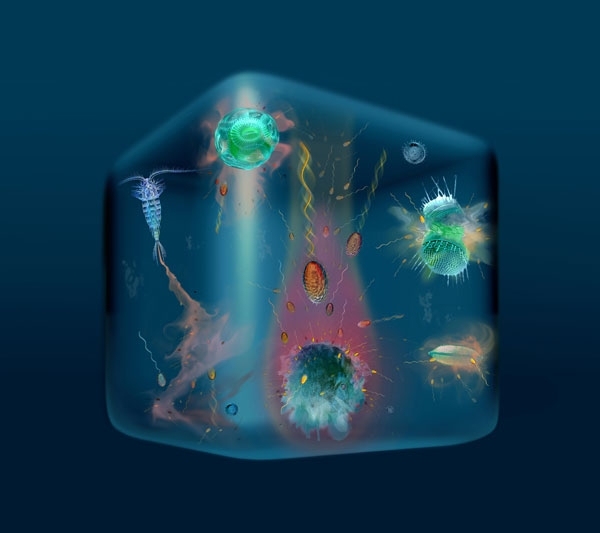
In order to illustrate this concept, Stocker, who studies the fluid mechanics and ecology of ocean microorganisms; artist Glynn Gorick; and former postdoctoral associate Justin Seymour, now a senior research fellow at the University of Technology Sydney, created an image of this dynamic seascape. The image was selected by the journal Science to grace the cover of its Feb. 5 issue, which highlights the Gordon Research Conferences, a 75-year-old nonprofit organization that will run 400 conferences on different topics in 2010.
To find out more about what the image depicts and how the scientists and artist work together, read an interview with Gorick, Seymour and Stocker at http://cee.mit.edu/news/releases/2010/microbe-art.
“Up to 20 years ago, the ocean was described as a ‘homogeneous soup’ at small scales,” Stocker said. “In that scenario, everything was well mixed and small organisms would not have had reason to be motile. But recent research has painted a different picture: the ocean is highly structured and heterogeneous even at minute scales. That is, even marine microbes experience a very dynamic seascape.”
In order to illustrate this concept, Stocker, who studies the fluid mechanics and ecology of ocean microorganisms; artist Glynn Gorick; and former postdoctoral associate Justin Seymour, now a senior research fellow at the University of Technology Sydney, created an image of this dynamic seascape. The image was selected by the journal Science to grace the cover of its Feb. 5 issue, which highlights the Gordon Research Conferences, a 75-year-old nonprofit organization that will run 400 conferences on different topics in 2010.
To find out more about what the image depicts and how the scientists and artist work together, read an interview with Gorick, Seymour and Stocker at http://cee.mit.edu/news/releases/2010/microbe-art.