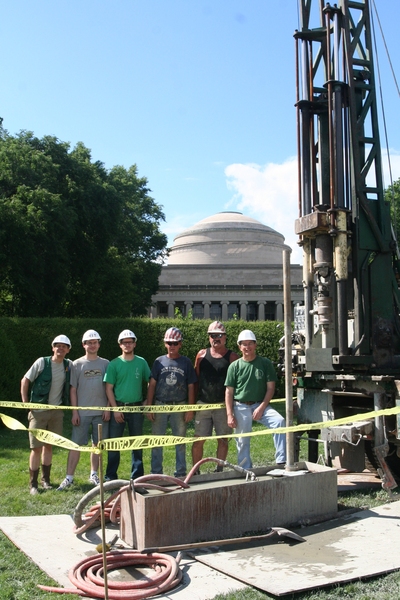
In a summer project run by senior research associate John Germaine of the Department of Civil and Environmental Engineering, a drilling rig on the lawn of Killian Court forced an experimental probe into the underlying clay to measure pore pressure, a soil characteristic that helps determine the stability of offshore oil platforms.
“Knowing the pore pressure allows engineers to more accurately determine underwater soil strength and better design wells and offshore platforms to avoid blowouts and collapse,” Germaine said. “It would be very useful to measure in-situ pore pressures very quickly, and our new design lets us predict the equilibrium pore pressures faster than any other tool.”
With previous funding from the National Science Foundation’s Ocean Drilling Program, Germaine, Matt Chartier SM ’05 and Peter Flemings of the University of Texas at Austin created a tapered probe to determine pore pressure and ground temperature. However, testing the device in the Gulf of Mexico proved difficult and expensive, with the drilling rig costing $200,000 per day. The team needed to find a place to test the new probe on land so they could gather data at a small fraction of the cost of renting an ocean rig.
Read more on the CEE website
“Knowing the pore pressure allows engineers to more accurately determine underwater soil strength and better design wells and offshore platforms to avoid blowouts and collapse,” Germaine said. “It would be very useful to measure in-situ pore pressures very quickly, and our new design lets us predict the equilibrium pore pressures faster than any other tool.”
With previous funding from the National Science Foundation’s Ocean Drilling Program, Germaine, Matt Chartier SM ’05 and Peter Flemings of the University of Texas at Austin created a tapered probe to determine pore pressure and ground temperature. However, testing the device in the Gulf of Mexico proved difficult and expensive, with the drilling rig costing $200,000 per day. The team needed to find a place to test the new probe on land so they could gather data at a small fraction of the cost of renting an ocean rig.
Read more on the CEE website