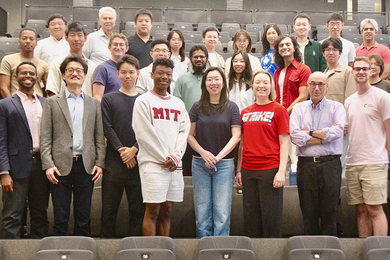
Third-year Department of Aeronautics and Astronautics graduate student Chad Lieberman has been awarded the Kambourides Fellowship in Computational Engineering. Lieberman’s master’s thesis introduced new methods for simultaneously reducing model size and parameter dimension in statistical inverse problems. His research focuses on the development of scalable numerical algorithms for inferring unknown physical properties using data collected in the field. Applications for his work could include nuclear waste storage planning, medical imaging and deep hydrocarbon exploration.
Lieberman’s work is, “nothing short of exceptional,” and a significant contribution to the field says Karen Willcox, professor of aeronautics and astronautics and co-director of the Center for Computational Engineering, which helps administer the Kambourides fellowship. Youssef Marzouk, Boeing Assistant Professor in AeroAstro, says Leiberman has “an instinct for numerical experimentation, supported by theory, which is very much in the spirit of computational engineering.” Lieberman has co-published four articles, given numerous talks, was runner up for the Bavarian Graduate School of Computational Engineering (BGCE) student paper prize, and was recipient of the AeroAstro Admiral Luis de Florez Award.
The Kambourides Graduate Fellowship in Computational Engineering was established in 2008 through the generous support of Miltos Kambourides, S.B. 1996, S.M. 1997. MIT’s first doctoral fellowship in computational engineering, the Kambourides Fellowship is awarded competitively based on short proposals. Emphasis is placed on fundamental research with potential long-term substantial impact on the foundations of computational engineering, and student accomplishments, quality, growth potential and communication skills. The fellowship award provides a 12-month stipend, tuition and fees; with possible renewal for a second year upon review. The fellowship is part of a series of coordinated activities across the School of Engineering in the emerging field of computational engineering.
Lieberman’s work is, “nothing short of exceptional,” and a significant contribution to the field says Karen Willcox, professor of aeronautics and astronautics and co-director of the Center for Computational Engineering, which helps administer the Kambourides fellowship. Youssef Marzouk, Boeing Assistant Professor in AeroAstro, says Leiberman has “an instinct for numerical experimentation, supported by theory, which is very much in the spirit of computational engineering.” Lieberman has co-published four articles, given numerous talks, was runner up for the Bavarian Graduate School of Computational Engineering (BGCE) student paper prize, and was recipient of the AeroAstro Admiral Luis de Florez Award.
The Kambourides Graduate Fellowship in Computational Engineering was established in 2008 through the generous support of Miltos Kambourides, S.B. 1996, S.M. 1997. MIT’s first doctoral fellowship in computational engineering, the Kambourides Fellowship is awarded competitively based on short proposals. Emphasis is placed on fundamental research with potential long-term substantial impact on the foundations of computational engineering, and student accomplishments, quality, growth potential and communication skills. The fellowship award provides a 12-month stipend, tuition and fees; with possible renewal for a second year upon review. The fellowship is part of a series of coordinated activities across the School of Engineering in the emerging field of computational engineering.