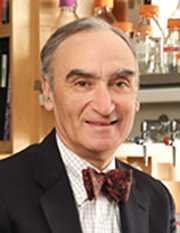
Whitehead Institute Founding Member Gerald Fink has been awarded the 2010 Genetics Prize of The Peter and Patricia Gruber Foundation for his groundbreaking research in yeast genetics.
“This is arguably the preeminent genetics prize in the world,” says Whitehead Institute Director David Page. “I’m sure Fink is greatly honored to join the prize’s very elite recipients.”
One of Fink’s greatest contributions to the field of genetics is transformation, a revolutionary technique enabling the insertion of a gene from any organism into a yeast cell, causing the yeast cell to produce the protein coded by the inserted gene. This advance allows scientists to study specific genes and to produce large amounts of compounds used in vaccines, antibiotics and even biofuel.
“This award was quite a surprise, a good surprise,” says Fink, who served as Whitehead Institute director from 1990 to 2001 and is also a professor of biology at MIT. “It represents recognition by my peers, which is really the ultimate, because these are the people who understand what I did.”
Gruber Genetics Prize Laureates are chosen by a board of prestigious geneticists seeking to honor a researcher whose work “provides new models that inspire and enable fundamental shifts in knowledge and culture” and “whose contributions in their respective fields advance our knowledge and potentially have a profound impact on our lives.”
Fink has continued his work in yeast genetics. Recently, his lab has found that genes in genetically very similar or even identical yeast can be expressed in markedly different ways, discoveries that may offer insights into human genetic diseases.
Fink will receive the Gruber Prize, which includes $500,000 and a gold medal, on Nov. 4, 2010, at the annual meeting of the American Society of Human Genetics, where he will also give a lecture.
In 2001, the inaugural Gruber Genetics Prize was awarded to another Whitehead Institute Founding Member, Rudolf Jaenisch, for his work in creating the first transgenic mouse used to study human disease.
“This is arguably the preeminent genetics prize in the world,” says Whitehead Institute Director David Page. “I’m sure Fink is greatly honored to join the prize’s very elite recipients.”
One of Fink’s greatest contributions to the field of genetics is transformation, a revolutionary technique enabling the insertion of a gene from any organism into a yeast cell, causing the yeast cell to produce the protein coded by the inserted gene. This advance allows scientists to study specific genes and to produce large amounts of compounds used in vaccines, antibiotics and even biofuel.
“This award was quite a surprise, a good surprise,” says Fink, who served as Whitehead Institute director from 1990 to 2001 and is also a professor of biology at MIT. “It represents recognition by my peers, which is really the ultimate, because these are the people who understand what I did.”
Gruber Genetics Prize Laureates are chosen by a board of prestigious geneticists seeking to honor a researcher whose work “provides new models that inspire and enable fundamental shifts in knowledge and culture” and “whose contributions in their respective fields advance our knowledge and potentially have a profound impact on our lives.”
Fink has continued his work in yeast genetics. Recently, his lab has found that genes in genetically very similar or even identical yeast can be expressed in markedly different ways, discoveries that may offer insights into human genetic diseases.
Fink will receive the Gruber Prize, which includes $500,000 and a gold medal, on Nov. 4, 2010, at the annual meeting of the American Society of Human Genetics, where he will also give a lecture.
In 2001, the inaugural Gruber Genetics Prize was awarded to another Whitehead Institute Founding Member, Rudolf Jaenisch, for his work in creating the first transgenic mouse used to study human disease.