Skip to content ↓

Testing a satellite's potential

Thirty-three MIT students who have been developing a satellite in the Space Systems Product Development course are using MIT Lincoln Laboratory's Environmental Test Laboratory to evaluate their design.
Professor David Miller from the Aeronautics and Astronautics Department works with graduate student and Air Force Lieutenant John Richmond as he verifies thermal sensor performance before starting the next phase of thermal vacuum testing.
Caption:
Professor David Miller from the Aeronautics and Astronautics Department works with graduate student and Air Force Lieutenant John Richmond as he verifies thermal sensor performance before starting the next phase of thermal vacuum testing.
Credits:
MIT Lincoln Laboratory
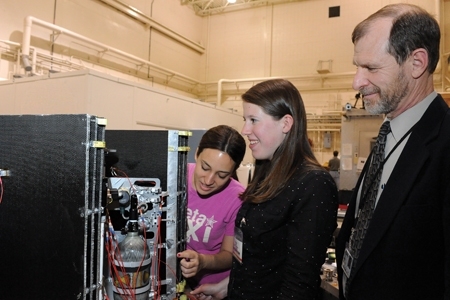
John Keesee looks on as the seniors Frances Gonzalez and Emily Grosse complete the installation of solar panel restraints on the satellite before they begin x-axis vibration tests.
Caption:
John Keesee looks on as the seniors Frances Gonzalez and Emily Grosse complete the installation of solar panel restraints on the satellite before they begin x-axis vibration tests.
Credits:
MIT Lincoln Laboratory
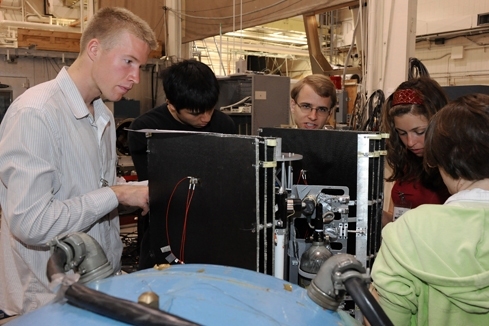
Left to right: Graduate student and Air Force Lieutenant Joseph Robinson and seniors Arthur Huang, Ryan McLinko, Victoria Stolyar, and Virginia Quaney perform vibration testing on satellite components at Lincoln Laboratory's Environmental Test Laboratory.
Caption:
Left to right: Graduate student and Air Force Lieutenant Joseph Robinson and seniors Arthur Huang, Ryan McLinko, Victoria Stolyar, and Virginia Quaney perform vibration testing on satellite components at Lincoln Laboratory's Environmental Test Laboratory.
Credits:
MIT Lincoln Laboratory

Related Topics

More MIT News

Globular blue and white orbs "examining" single-stranded RNA products and marking them with green checks or red x's

Why are some bacterial genes high in purines?

In certain species of bacteria, the answer lies in shielding RNA transcripts from a quality-control factor called Rho. Understanding the requirements for expressible sequences is critical for expression engineering of therapeutic agents.

Read full story

Rich Nielsen, Volha Charnysh, Kevin Dorst, and Emily Richmond Pollock seated at a table, talking

Building a scholarly community

The SHASS Faculty Fellows Program, administered by the MIT Human Insight Collaborative, is fostering new research projects and creating space for supportive and interdisciplinary discussion.

Read full story