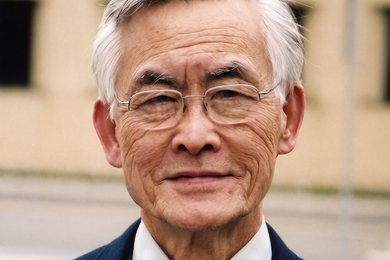
Kenneth Wright '47, S.M. '55, a physicist who spent more than 60 years at MIT researching the effects of radiation, died Jan. 7. He was 88.
Wright's area of expertise was in determining the radiation doses required to sterilize, pasteurize and modify materials, and in verifying the effects of these doses on irradiated materials.
Markus Zahn, the Thomas and Gerd Perkins Professor of Electrical Engineering, worked with Wright at the High Voltage Research Laboratory (HVRL) in the Department of Electrical Engineering, and was his neighbor and friend. Zahn said he remembered Wright as a skilled collaborator on many diverse projects applying ionizing radiation to radiation oncology and to physical, biological, and chemical systems including radiation sterilization of foods and body tissue materials; use of radiation to prolong the life of polyethylene material used in hip replacements; disinfection of waste water sludge by electron beam radiation; and use of radiation to examine cargo containers for dangerous materials.
Wright came to MIT from the U.S. Army, where he worked on radar during World War II. Between 1947 and 1985, he worked as a physicist staff member of the HVRL. In 1985, he became a half-time staffer in HVRL and in 1995 moved to part-time. During his career, he authored or co-authored more than 70 research papers.
Wright is survived by his wife, Marguerite (Fleming) Wright, four daughters, six grandchildren and two great-grandchildren. A memorial service was held Jan. 12 in Lexington, Mass., where he lived. In lieu of flowers, donations in his memory may be made to any of the following: DeCordova Museum, Lahey Clinic, Church of Our Redeemer, Sandy Bay Yacht Club (Education Fund) or Haverford College.
A version of this article appeared in MIT Tech Talk on January 30, 2008 (download PDF).