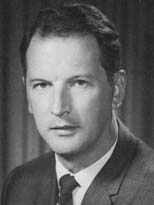
Harald A. Enge, retired professor of physics and member of the Laboratory for Nuclear Science, died April 14 of respiratory failure. He was 87.
Enge was director of MIT's Van de Graff Research Group for many years and was an acknowledged world leader in the design of magnetic spectrometers for nuclear physics, instruments used to determine the energy spectrum of nuclear particles.
Born in Fauske, Norway, in 1920, Enge earned the equivalent of a master's degree in electrical engineering from Trondheim University in 1946. Before graduating, he spent a year helping the Norwegian Underground Resistance as a secret radio repairman during World War II.
He earned a PhD in physics from the University of Bergen in 1954, based mostly on nuclear physics research he did at MIT in 1950 and 1951. He returned to MIT in 1955 as an assistant professor and became a full professor in 1959.
Enge held more than 20 patents for inventions in a wide range of fields, including magnetic and electric optics, accelerators, power supplies and mass separators. He also wrote a popular textbook called "Introduction to Nuclear Physics."
He won the Tom W. Bonner Prize in Nuclear Physics from the American Physical Society in 1984.
Enge retired from MIT in 1986 to spend more time with his first wife, Grete, who passed away in 1988. He is survived by his second wife, Alice (Williams); three sons, Kjell of Carlyle, Pa., Per of Mountain View, Calif., and Eric of Southborough, Mass.; a stepson, John Emery of Washington; a stepdaughter, Jeanne Bassett of Sandia Park, N.M.; seven grandchildren and five great-grandchildren.
Funeral arrangements are private.
A version of this article appeared in MIT Tech Talk on April 30, 2008 (download PDF).