Skip to content ↓

DUSP show eyes urban design, civil protest

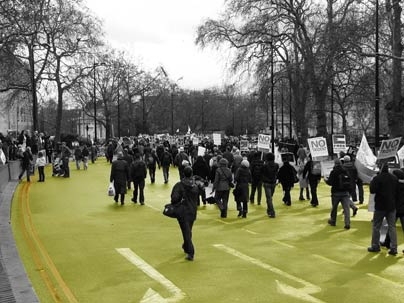
In one image from the new DUSP exhibit, 'Urban Design and Civil Protest,' a crowd has appropriated a prestigious public space in London as part of a 2007 peace protest. Exhibit creator Tali Hatuka uses visual and other media to explore how urban space is used as an instrument for civil protests. The exhibit opens Feb. 28 in the Compton Gallery.
Caption:
In one image from the new DUSP exhibit, 'Urban Design and Civil Protest,' a crowd has appropriated a prestigious public space in London as part of a 2007 peace protest. Exhibit creator Tali Hatuka uses visual and other media to explore how urban space is used as an instrument for civil protests. The exhibit opens Feb. 28 in the Compton Gallery.

"Urban Design and Civil Protest," a new exhibition conceived as a multimedia laboratory for examining the social and spatial dynamics of protests, will be on view from Feb. 28 to June 9 in the MIT Museum Compton Gallery.

The exhibit, created by visiting architect and urban designer Tali Hatuka, celebrates the 75th anniversary of MIT's Department of Urban Studies and Planning.

Hatuka's study of urban protests includes a lexicon of their different shapes--they occur in circular, grid and concentric forms--and a code for identifying key moments during protests when the outcome turns to violence. In addition, the voices and faces of people engaged in protest bring the process alive for viewers: A sound installation from various events plays individual and crowd voices in public space; a video screen projects messages, slogans and banners from protests around the world and still photographs capture singular, intimate moments in a protesting crowd.

The Marie Curie Research Fellow in urban studies and planning, Hatuka received the PhD from Technion, the Israel Institute of Technology. Her research awards include the European Community Marie Curie Fellowship (2005-2008) and a Fulbright Postdoctoral Fellowship (2004-2005).

The Compton Gallery is free and open daily 10:00 a.m. to 5:00 p.m.

A version of this article appeared in MIT Tech Talk on February 27, 2008 (download PDF).

Related Links

Related Topics

More MIT News

Globular blue and white orbs "examining" single-stranded RNA products and marking them with green checks or red x's

Why are some bacterial genes high in purines?

In certain species of bacteria, the answer lies in shielding RNA transcripts from a quality-control factor called Rho. Understanding the requirements for expressible sequences is critical for expression engineering of therapeutic agents.

Read full story

Rich Nielsen, Volha Charnysh, Kevin Dorst, and Emily Richmond Pollock seated at a table, talking

Building a scholarly community

The SHASS Faculty Fellows Program, administered by the MIT Human Insight Collaborative, is fostering new research projects and creating space for supportive and interdisciplinary discussion.

Read full story