Skip to content ↓

Time magazine honors MIT for inventions, inventors

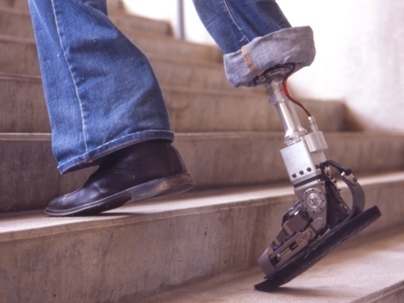
The robotic ankle is one of six MIT inventions singled out by Time magazine in its annual survey of the world's most promising visions of the future. MIT Media Lab Professor Hugh Herr and his team of researchers developed the world's first such ankle, an important advance for lower-limb amputees. <a onclick="MM_openBrWindow('time-ankle-enlarged.html','','width=509, height=583')">
<span onmouseove...
Caption:
The robotic ankle is one of six MIT inventions singled out by Time magazine in its annual survey of the world's most promising visions of the future. MIT Media Lab Professor Hugh Herr and his team of researchers developed the world's first such ankle, an important advance for lower-limb amputees. <a onclick="MM_openBrWindow('time-ankle-enlarged.html','','width=509, height=583')">
<span onmouseover="this.className='cursorChange';">Open image gallery</span>
</a>
<noscript> <a href="time-ankle-enlarged.html">
<em>(no JavaScript)</em>
</a>
</noscript>
Credits:
Photo / Webb Chappell

Six MIT inventions and two MIT inventors were celebrated as the best of 2007 in Time magazine's annual survey of the world's most promising--and sometimes startling--visions of the future, as seen by scientists, engineers, educators and designers.

The two inventors chosen by Time are Tim -Berners-Lee and Vannevar Bush.

Berners-Lee, senior researcher and holder of the 3Com Founders Chair at MIT's Computer Science and Artificial Intelligence Laboratory, is known as the father of the web. He proposed it in 1989, launched it on the Internet in 1991 and continues to guide its evolution in his role as founder and director of the World Wide Web Consortium (W3C), an international forum.

MIT's first dean of engineering, Bush developed a modern analog computer to solve complex equations during the 1930s. Bush envisioned what he called a "mechanized private file and library of exceeding speed and flexibility," opening the door to breakthroughs in computer and Internet technology.

Time singled out MIT inventions that may improve life for people living in cities, in space, in remote or disadvantaged areas, or with disabilities.

See photo gallery at right to learn about the six inventions.

A version of this article appeared in MIT Tech Talk on November 14, 2007 (download PDF).
Related Links

Related Topics

More MIT News

Globular blue and white orbs "examining" single-stranded RNA products and marking them with green checks or red x's

Why are some bacterial genes high in purines?

In certain species of bacteria, the answer lies in shielding RNA transcripts from a quality-control factor called Rho. Understanding the requirements for expressible sequences is critical for expression engineering of therapeutic agents.

Read full story

Rich Nielsen, Volha Charnysh, Kevin Dorst, and Emily Richmond Pollock seated at a table, talking

Building a scholarly community

The SHASS Faculty Fellows Program, administered by the MIT Human Insight Collaborative, is fostering new research projects and creating space for supportive and interdisciplinary discussion.

Read full story