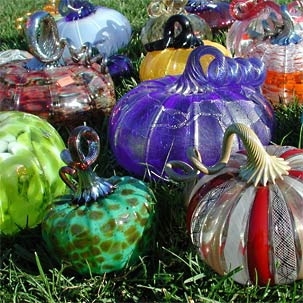
It's a bumper crop you won't want to bump too hard:Â More than 1,000 hand-blown glass pumpkins, squashes and gourds in all shapes, sizes, colors and designs will be sold as part of MIT's annual Great Glass Pumpkin Patch.
The Great Glass Pumpkin Patch begins with a preview reception Friday, Oct. 5 from 5 to 8 p.m. on Kresge Oval. The following day, Oct. 6, between 10 a.m. and 3 p.m., shoppers and browsers will be able to purchase their favorite autumnal orb. Prices range from $20 to $200, depending on the piece's size and complexity. Many of the works feature vivid colors, swirls, stripes, spots, curlicues and unusual stems.
The rain date is Oct. 7, from 10 a.m. to 3 p.m.
The glass pumpkins were created by students and instructors in MIT's Glass Lab, where members of the MIT community learn and practice the art of glassblowing. Proceeds from this event benefit the lab, an art program connected with MIT's Department of Materials Science and Engineering. Pumpkin-making is overseen by glass artist Peter Houk, director of the MIT Glass Lab in the Department of Materials Science and Engineering.
The Great Glass Pumpkin Patch came to MIT in 2001 after a residency in the Glass Lab by 14 members of the Bay Area Glass Institute (BAGI). BAGI (a nonprofit corporation located in San Jose, Calif.), was founded in 1995 by San Jose State graduate Bobby Bowes and MIT alumnus Mike Binnard.
Every week or so, beginning, intermediate and advanced students work together for a few hours in teams of six or seven to produce pumpkins for the sale. Production for the October event continues steadily throughout the year in order to achieve the goal of 1,000 to 1,200 pumpkins.
For more information, including an illustrated step-by-step description of "How To Make a Pumpkin," see: web.mit.edu/glasslab/sales_pumpkin.html, or call (617) 253-5309.
A version of this article appeared in MIT Tech Talk on October 3, 2007 (download PDF).