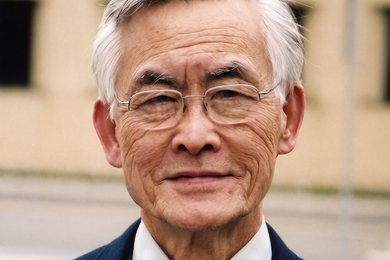
Akiva Yaglom, a research fellow in the Department of Aeronautics and Astronautics and an expert in turbulence theory, passed away Dec. 12 following a brief illness. He was 86.
Yaglom was born in 1921 in Kharkov, Ukraine, and moved to Moscow in 1926. He worked at the Institute of Atmospheric Physics, Academy of Sciences and was a full professor in the Probability Theory and Statistics Department of Moscow University.
Yaglom received a Doctor of Science degree--the highest scientific degree in the Soviet Union--in 1955 for work on theories of stochastic processes and their application to turbulence theory.
In 1988, he received the American Physical Society's Otto Laporte Award for his "fundamental contribution to the statistical theory of turbulence and the study of its underlying mathematical structure."
In 1992, Yaglom came to the United States and MIT. He was subsequently granted permanent resident status.
Yaglom authored six books and some 120 papers. Most of his materials have been published in English and many other languages and are regarded as engineering classics. They include the two-volume set Statistical Fluid Mechanics, published by MIT Press.
Yaglom had been scheduled to receive the European Geosciences Union's Lewis Fry Richardson Medal next spring honoring his work in nonlinear geosciences.
He is survived by his wife and several children.
A version of this article appeared in MIT Tech Talk on January 30, 2008 (download PDF).