Skip to content ↓

MIT Press wins prestigious international award

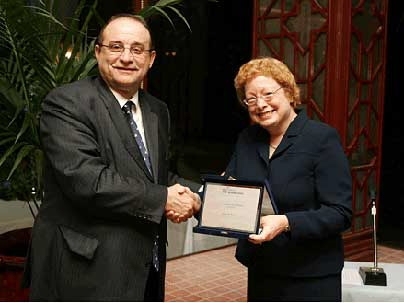
Ellen W. Faran, director of The MIT Press, receives the Grinzane-Cavour Award from Giuliano Soria, President and Founder of the Grinzane-Cavour, at the awards ceremony in Turin, Italy.
Caption:
Ellen W. Faran, director of The MIT Press, receives the Grinzane-Cavour Award from Giuliano Soria, President and Founder of the Grinzane-Cavour, at the awards ceremony in Turin, Italy.

Ellen W. Faran, Director of the MIT Press, has received the 2007
Grinzane-Cavour Award in recognition of MIT Press' contributions, both substantial and ethical, to the publication of scientific and humanistic titles.

Faran, who accepted the award on behalf of the Press, is the seventh recipient of the prize.

As part of the award events held in Turin, Italy, Faran joined in a panel discussion on scientific and humanistic publishing, addressing the question of whether these publishing missions constitute a single or separate enterprises. Journalists, writers, publishers, and Italian scientists and historians of science participated in the discussion.

The Grinzane Cavour Prize, presented by Giuliano Soria, has been awarded previously to Hans Magnus Enzensberger (2001), André Schiffrin (2002), Antoine Gallimard (2003), Odile Jacob (2004), Jorge Herralde (of Anagrama in Spain, 2005), and Ulla Unseld Berkéwicz (2006).

Related Links

Related Topics

More MIT News

Rich Nielsen, Volha Charnysh, Kevin Dorst, and Emily Richmond Pollock seated at a table, talking

Building a scholarly community

The SHASS Faculty Fellows Program, administered by the MIT Human Insight Collaborative, is fostering new research projects and creating space for supportive and interdisciplinary discussion.

Read full story

Globular blue and white orbs "examining" single-stranded RNA products and marking them with green checks or red x's

Why are some bacterial genes high in purines?

In certain species of bacteria, the answer lies in shielding RNA transcripts from a quality-control factor called Rho. Understanding the requirements for expressible sequences is critical for expression engineering of therapeutic agents.

Read full story